

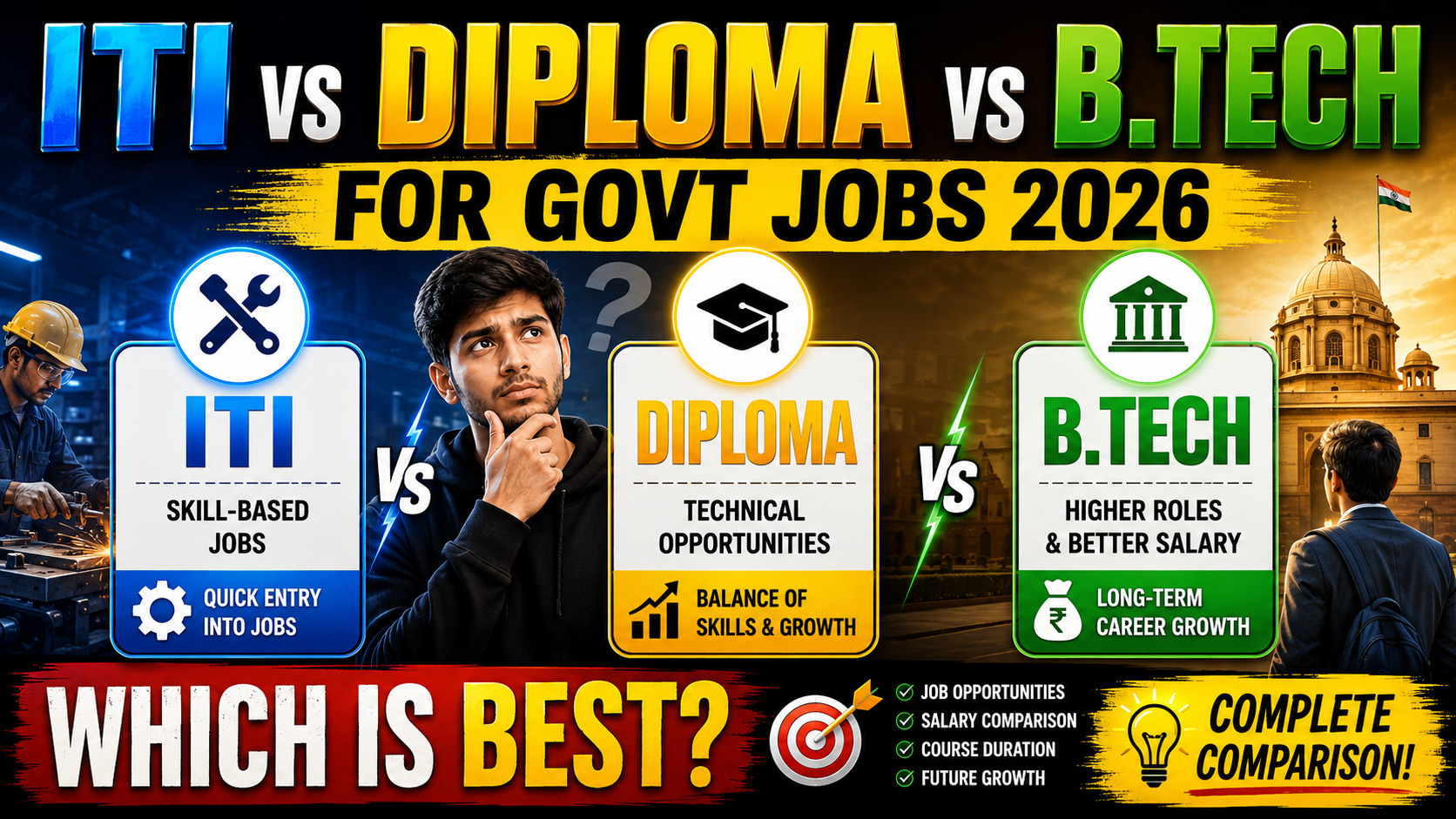
Every year, millions of students across India stand at a crossroads after their Class 10 or Class 12 board exams, asking the same burning question: Should I go for an ITI, a Polytechnic Diploma, or a full B.Tech degree — especially if my goal is a stable government job?
This question is more relevant in 2026 than ever before. With the Indian government announcing bumper recruitments across Railways, Defence, PSUs, and State Electricity Boards, the technical job market has exploded with opportunity. But here is the catch - each qualification unlocks a different set of doors, with different pay scales, different competition levels, and very different timelines.
In this comprehensive guide, we break down all three pathways - ITI, Diploma, and B.Tech - across every dimension that matters for government job aspirants: course duration, eligibility, government exam applicability, vacancy count, salary under the 7th Pay Commission, and long-term career growth. We have also included detailed comparison tables so you can evaluate everything at a glance.
Whether you want to join the Railways as a Technician, land a Junior Engineer post, or crack the UPSC Engineering Services exam — this guide will tell you exactly which qualification is your fastest and most rewarding route to a Sarkari Naukri.
ITI stands for Industrial Training Institute. These are government-recognized vocational training centres that operate under the Directorate General of Training (DGT), Ministry of Skill Development and Entrepreneurship. ITI courses are available to students who have passed Class 8, 10, or 12 depending on the trade chosen. The duration ranges from 6 months to 2 years, and successful students receive the National Trade Certificate (NTC) or National Apprenticeship Certificate (NAC) accredited by NCVT (National Council for Vocational Training) or SCVT (State Council of Vocational Training).
Popular trades include Electrician, Fitter, Welder, Turner, Diesel Mechanic, COPA (Computer Operator and Programming Assistant), Plumber, Wireman, and Electronic Mechanic, among many others. In 2026, ITIs play a pivotal role in India's Skill India Mission and National Apprenticeship Promotion Scheme (NAPS).
A Polytechnic Diploma (commonly called simply 'Diploma') is a 3-year technical education programme offered by government and private polytechnic institutes. Admission requires Class 10 completion, and the curriculum blends theoretical knowledge with practical laboratory work. Diploma programmes are approved by the All India Council for Technical Education (AICTE) and affiliated to State Boards of Technical Education. Popular branches include Civil Engineering, Mechanical Engineering, Electrical Engineering, Electronics & Communication, Computer Science, and Chemical Engineering.
Diploma holders can apply for Junior Engineer (JE) posts in government and are also eligible for lateral entry into the second year of a B.Tech programme at most universities - a huge flexibility advantage.
Bachelor of Technology (B.Tech) is a 4-year undergraduate engineering degree offered by universities, NITs, IITs, and thousands of private engineering colleges across India. Admission is based on Class 12 (PCM) marks and entrance exams such as JEE Main, JEE Advanced, or state-level CETs. B.Tech holders are eligible for officer-level government posts including UPSC Engineering Services (IES), SSC JE (in many cases), PSU campus recruitment, and State PSC Engineering positions. The degree is the highest-ranked technical qualification for direct entry into Class I and Class II government services.
| Parameter | ITI | Diploma (Polytechnic) | B.Tech / B.E. |
|---|---|---|---|
| Minimum Eligibility | Class 8 / Class 10 | Class 10 (PCM) | Class 12 (PCM) + JEE |
| Course Duration | 6 months – 2 years | 3 years | 4 years |
| Certification Body | NCVT / SCVT | State Board of Technical Education | University / AICTE |
| Focus Area | Hands-on trade skill | Technical knowledge + practical | Theory + research + design |
| Govt Exam Level | Group D / Group C | Group C / Junior Engineer | JE / AE / Class I officer |
| Approx. Course Fee (Govt. Institute) | ₹2,000 – ₹10,000/year | ₹8,000 – ₹25,000/year | ₹50,000 – ₹1,50,000/year |
| Job Entry Age | 18–20 years (fastest) | 20–22 years | 22–24 years |
| Higher Study Option | Diploma (Lateral, Year 2) | B.Tech (Lateral, Year 2) | M.Tech / MBA / UPSC |
Understanding which qualification makes you eligible for which government posts is the single most important factor in this comparison. Let us break it down sector by sector.
Indian Railways is the single largest employer of technical personnel in India, releasing over 50,000+ technical vacancies annually across various zones and departments. In 2026, RRB announced 33,320+ Group D (Level 1) posts, 11,127 Assistant Loco Pilot (ALP) posts, and 6,565 Technician Grade 1 and Grade 3 posts, with more recruitments expected throughout the year.
| Railway Post | Required Qualification | Pay Level (7th CPC) | Approx. In-Hand Salary |
|---|---|---|---|
| Group D (Track Maintainer, Helper) | Class 10 + ITI (relevant trade) | Level 1 (₹18,000 basic) | ₹25,000 – ₹32,000/month |
| Technician Grade 3 | Class 10 + ITI (relevant trade) | Level 2 (₹19,900 basic) | ₹27,000 – ₹36,000/month |
| Technician Grade 1 (Signal) | Diploma / B.Sc | Level 5 (₹29,200 basic) | ₹42,000 – ₹52,000/month |
| Assistant Loco Pilot (ALP) | Class 10 + ITI / Diploma | Level 2 (₹19,900 basic) | ₹27,000 – ₹38,000/month |
| Junior Engineer (JE) | Diploma or B.Tech | Level 6 (₹35,400 basic) | ₹48,000 – ₹62,000/month |
| Senior Section Engineer | B.Tech / B.E. | Level 7 (₹44,900 basic) | ₹62,000 – ₹80,000/month |
| UPSC IES (Engineering Services) | B.Tech / B.E. | Level 10 (₹56,100 basic) | ₹80,000 – ₹1,20,000/month |
Key insight: ITI holders dominate the high-volume Technician and Group D recruitments. Diploma holders can apply for both ALP and Junior Engineer posts, making Diploma the most versatile qualification for Railway jobs. B.Tech opens the door to Senior Engineer and officer-level positions.
PSUs such as BHEL, SAIL, GAIL, IOCL, HPCL, ONGC, BEL, DRDO, and ISRO regularly recruit technical personnel at multiple levels. The qualification hierarchy is very clear across all PSUs.
| PSU Post | Qualification Required | Approx. CTC (Annual) |
|---|---|---|
| Apprentice / Trade Apprentice | ITI (relevant trade) | ₹1.0L – ₹1.8L (stipend) |
| Technician Apprentice | Diploma in Engineering | ₹1.5L – ₹2.4L (stipend) |
| Junior Technician / Artisan | ITI + experience | ₹3.5L – ₹5.0L |
| Technician (Diploma Level) | Diploma in Engineering | ₹4.5L – ₹7.0L |
| Graduate Apprentice Engineer | B.Tech / B.E. | ₹2.5L – ₹3.6L (stipend) |
| Executive / Management Trainee | B.Tech via GATE | ₹9.0L – ₹14.0L |
PSU GATE recruitment (for Executive / MT posts) is exclusively open to B.Tech graduates. The salary jump between a Diploma-level Technician post and a GATE-based MT post is enormous- often 2x to 3x in entry-level CTC.
JVVNL (Rajasthan), PSPCL (Punjab), TNEB (Tamil Nadu), MSEDCL (Maharashtra), and similar State Electricity Boards recruit thousands of Linemen, Junior Engineers, and Assistant Engineers every year. ITI holders in Electrician and Lineman trades have dedicated quota in Lineman posts. Diploma holders are eligible for Junior Engineer (Electrical) posts. B.Tech graduates can apply for Assistant Engineer (AE) and Deputy Engineer posts, which are the highest entry-level technical positions.
The Indian Defence establishment offers multiple pathways for all three qualification levels. ITI holders can join as Multi-Skilled Workers (MSW), Vehicle Mechanics, or Tradesman Mates through Army ordnance, GREF, and BRO recruitments. Diploma holders can apply as Aircraft Technicians in the Indian Air Force and Technical Sailor/Artificer roles in the Indian Navy. B.Tech holders are eligible for commissioned officer roles through UPSC CDS Technical entries, NDA Science entries, and DRDO/ISRO Scientist posts.
SSC is one of the largest recruiters of central government technical staff.
| SSC Exam | Required Qualification | Post Type | Pay Level |
|---|---|---|---|
| SSC JE (Junior Engineer) | Diploma or B.Tech | Junior Engineer — Civil/Electrical/Mech | Level 6 (₹35,400) |
| SSC CHSL | Class 12 (not technical) | LDC / DEO / Postal | Level 2–4 |
| SSC CGL | Any graduate / B.Tech | Inspector / Officer / JSO | Level 4–8 |
| SSC Selection Post | Class 10 / 12 / Graduate | Various Ministries | Level 1–8 |
Salary in government jobs is not just the basic pay — it includes Dearness Allowance (DA, currently 58% of Basic as of 2026), House Rent Allowance (HRA, 8–27% based on city), Transport Allowance (TA), medical benefits under CGHS, and pension or NPS contribution. The 8th Pay Commission has been approved by the Union Cabinet and is expected to revise salaries upward, with implementation likely from January 2026 onwards.
| Qualification | Typical Entry Post | Pay Level | Basic Pay (₹/month) | Approx. In-Hand Salary | Annual CTC (Approx.) |
|---|---|---|---|---|---|
| ITI | Technician / Group D | Level 1–2 | ₹18,000 – ₹19,900 | ₹25,000 – ₹36,000 | ₹3.0L – ₹4.3L |
| ITI + Apprenticeship | Jr. Technician / Trade Asst. | Level 2–3 | ₹19,900 – ₹21,700 | ₹30,000 – ₹42,000 | ₹3.6L – ₹5.0L |
| Diploma | Junior Engineer / Technician Gr.1 | Level 5–6 | ₹29,200 – ₹35,400 | ₹42,000 – ₹58,000 | ₹5.0L – ₹7.0L |
| B.Tech (JE Level) | Junior Engineer / Asst. Engineer | Level 6–7 | ₹35,400 – ₹44,900 | ₹52,000 – ₹72,000 | ₹6.2L – ₹8.6L |
| B.Tech (GATE / PSU MT) | Management Trainee / Executive | Level 8–10 | ₹47,600 – ₹56,100 | ₹80,000 – ₹1,20,000 | ₹9.0L – ₹14.0L |
| B.Tech (IES / Class I) | Group A Engineering Officer | Level 10–12 | ₹56,100 – ₹78,800 | ₹90,000 – ₹1,50,000 | ₹12.0L – ₹18.0L |
The salary difference between an ITI-level Technician and a B.Tech-level Management Trainee in a PSU can be 3x to 4x at the entry level — but remember that an ITI student starts earning 4–6 years earlier than a B.Tech graduate. This time-value of money is a critical factor often overlooked in comparison studies.
Raw vacancy count is a crucial factor for government job aspirants, because more vacancies mean more chances of selection. Here is how the three qualifications compare in 2026 based on officially released recruitment notifications.
| Recruiting Body | ITI Vacancies (2026) | Diploma Vacancies (2026) | B.Tech Vacancies (2026) |
|---|---|---|---|
| Indian Railways (RRB) | 40,000+ (Technician, Group D, ALP) | 5,000–8,000 (ALP + JE) | 2,585+ (JE, SSE) |
| Defence (Army, Navy, AF, GREF) | 10,000+ (Tradesman, MSW) | 2,000–4,000 (Tech Asst.) | 3,000+ (Officer entries) |
| State Electricity Boards | 8,000–12,000 (Lineman, Asst.) | 4,000–6,000 (JE Electrical) | 1,500–3,000 (AE / DE) |
| PSUs (BHEL, ONGC, SAIL, etc.) | 5,000+ (Apprentice, Artisan) | 4,000–6,000 (Tech Apprentice, JE) | 8,000–12,000 (GATE MT) |
| SSC (JE, CGL, CHSL) | Limited (selective trades) | 3,000–5,000 (SSC JE) | 5,000–8,000 (SSC JE + CGL) |
| State PSCs (Across All States) | Varies (Skilled Worker) | 6,000–10,000 (JE posts) | 4,000–8,000 (AE / JE) |
| Rough Total Estimate (2026) | ~70,000–80,000+ | ~25,000–35,000 | ~25,000–35,000 |
In sheer volume, ITI qualification opens the most government job vacancies — primarily because Railway Group D and Technician posts alone account for 40,000–50,000 vacancies in a single cycle. However, competition for ITI posts is also extremely high, with lakhs of applicants per batch. Diploma and B.Tech posts are fewer in number but often attract less competition per seat, especially at the Junior Engineer level.
An ITI candidate who joins as a Group D employee or Technician Grade 3 in Railways can progress through departmental exams and seniority-based promotions to become Technician Grade 1, Senior Technician, Junior Engineer (through LDCE - Limited Departmental Competitive Examination), Section Engineer, and even Senior Section Engineer over a 20–25 year career. However, the ceiling without higher qualifications is relatively lower.
The smartest move for an ITI holder is the lateral entry pathway: ITI → Diploma (Lateral Entry, Year 2) → B.Tech (Lateral Entry, Year 2). This allows a student to start earning early via an apprenticeship or job while simultaneously upgrading qualifications — without wasting any years.
A Diploma holder entering as Junior Engineer can become Section Engineer, Assistant Divisional Engineer, Divisional Engineer, and Senior Divisional Engineer through internal exams and seniority. Many government departments allow Diploma holders to apply for B.Tech level posts after acquiring 2–3 years of experience through the AMIE route (Associate Membership of Institution of Engineers) or through part-time/distance B.Tech programmes. This makes Diploma the most balanced pathway — early entry + clear upward mobility.
A B.Tech graduate entering via GATE into a PSU as Management Trainee or through UPSC IES as Group A officer has the highest starting salary and fastest promotion trajectory. IES officers can become Chief Engineer / Principal Chief Engineer within 20–25 years, with salaries reaching ₹2.0 lakh+ per month at senior levels. B.Tech graduates in SSC JE or State JE posts also have a clear path to Section Officer and Executive Engineer through departmental promotions.
| Qualification | Entry Post | 5-Year Position | 15-Year Position | Peak Career Position |
|---|---|---|---|---|
| ITI | Technician / Group D | Technician Grade 1 | Senior Technician / JE (LDCE) | Section Engineer / JE |
| Diploma | Junior Engineer | Senior JE / Section Engineer | Asst. Divisional Engineer | Divisional / Executive Engineer |
| B.Tech (JE route) | Junior Engineer | Section Engineer | Divisional Engineer | Chief Engineer |
| B.Tech (GATE/PSU) | Management Trainee | Senior Engineer / Manager | Deputy General Manager | General Manager / Director |
| B.Tech (IES / UPSC) | Group A Officer (Asst. Ex. Eng.) | Executive Engineer | Superintending Engineer | Chief Engineer / Principal Chief Engineer |
| ITI Advantages | ITI Disadvantages |
|---|---|
| Fastest route to employment (1–2 years) | Lower starting salary in government jobs |
| Highest vacancy volume in Railways & Defence | Limited officer-level opportunities |
| Very low course fees (₹2,000–₹10,000/year) | Promotions are slower without higher qualification |
| Eligible for NAPS apprenticeship during course | Faces heavy competition from lakhs of applicants |
| Lateral entry into Diploma Year 2 after completion | Not eligible for GATE-based PSU recruitment |
| Gulf/overseas job opportunities in skilled trades | Relatively lower social recognition vs. degree |
| Diploma Advantages | Diploma Disadvantages |
|---|---|
| Eligible for Junior Engineer posts directly | Takes 3 years before job eligibility |
| Balance of practical skill and technical theory | Higher fees than ITI in private polytechnics |
| Lateral entry option into B.Tech Year 2 | Not eligible for highest PSU posts (GATE MT) |
| Most versatile qualification across government sectors | Competition with B.Tech candidates in JE exams |
| SSC JE, RRB JE, State JE — all accessible | Post of Assistant Engineer often requires B.Tech |
| Can apply for both ITI-level and JE-level posts in many exams | Degree recognition varies across private sector |
| B.Tech Advantages | B.Tech Disadvantages |
|---|---|
| Highest salary at entry level in government | Takes 4 years (6+ years from Class 10) |
| Eligible for UPSC IES, GATE, Class I Services | High course fees in private colleges (₹4–15L total) |
| Best long-term career growth and peak salary | JEE competition is extremely intense |
| Campus placement options in private sector also | Not all B.Tech graduates crack PSU GATE cutoffs |
| GATE score opens PSU, IIT M.Tech, and research | Risky investment if not from good college |
| Most prestigious and socially recognized qualification | Older entry age means delayed financial independence |
| Qualification | Best Trade / Branch | Why It's Best for Govt Jobs |
|---|---|---|
| ITI | Electrician | Max vacancies in Railways, Electricity Boards, DRDO, PSUs |
| ITI | Fitter | Core trade for Railways (Group D, Technician), BHEL, ISRO |
| ITI | Diesel Mechanic | Heavy demand in Railways, Defence Workshops, BRO, GREF |
| ITI | Electronic Mechanic | DRDO, ISRO, BEL, Air Force technical roles |
| ITI | COPA (Computer Operator) | Clerical-level govt jobs, lower competition |
| Diploma | Electrical Engineering | Railways JE, State Electricity Board JE, SSC JE |
| Diploma | Civil Engineering | SSC JE, State PWD JE, CPWD, MES vacancies |
| Diploma | Mechanical Engineering | BHEL, ISRO, Defence, Railways JE |
| Diploma | Electronics & Communication | BSNL, BEL, DRDO, Air Force tech posts |
| B.Tech | Electrical / Electronics | GATE PSUs (BHEL, NTPC, PGCIL), IES |
| B.Tech | Civil Engineering | UPSC IES, CPWD, SSC JE senior posts, NHB |
| B.Tech | Computer Science | NIC, CDAC, SSC CGL (JSO), PSU IT roles |
| B.Tech | Mechanical Engineering | GATE PSUs (BHEL, GAIL, ONGC), IES Mechanical |
There is no single universal answer. The right choice depends entirely on your personal situation, financial condition, academic performance, and long-term ambitions. Here is a practical framework to help you decide.
| Your Situation | Recommended Qualification | Why |
|---|---|---|
| Need income within 2 years, limited budget | ITI | Fastest employment, lowest fee, immediate Railway/PSU apprenticeship |
| Want a JE post but cannot afford 4-year degree | Diploma | Directly eligible for JE in Railways, SSC, State Boards |
| Strong in PCM, want highest salary & growth | B.Tech (JEE route) | Access to GATE PSU, IES, officer-level posts |
| Want to do B.Tech but need money now | ITI → Diploma → B.Tech (ladder) | Earn early via ITI + apprenticeship, then upgrade |
| Weak in academics, good with hands-on work | ITI | Skill-based certification, less academic pressure |
| Want overseas (Gulf) job + govt job option | ITI (Electrician/Fitter) | Gulf countries hire ITI skilled workers actively |
| Parent is a govt employee, want same department | Match qualification to parent's department post level | Use departmental quota / EWS advantage |
| Want to teach in Govt ITI as instructor | ITI → CITS (Craft Instructor Training Scheme) | Govt ITI instructor salary ₹55,000–₹72,000/month |
The single most effective career strategy for government job aspirants in 2026 is the qualification ladder approach. Here is how it works and why it outperforms choosing any single path blindly.
| Year | Stage | What You Do | Financial Status |
|---|---|---|---|
| Year 1–2 | ITI Course | Complete ITI (e.g., Electrician trade) | Study + Part-time apprenticeship prep |
| Year 2–3 | NAPS Apprenticeship | Register under NAPS — earn ₹8,000–₹12,000/month stipend | Earning while training |
| Year 3–5 | Diploma (Lateral Entry Year 2) | Join Diploma 2nd year directly — save 1 year | Still earning from apprenticeship |
| Year 5–6 | Govt Job Attempt (JE Level) | Apply for Railway JE / SSC JE / State JE | Job + studies combined |
| Year 6–8 | B.Tech (Lateral Entry Year 2) | Join B.Tech 2nd year — optional for officer posts | Employed + studying |
| Year 8+ | GATE / IES / Promotion | Attempt GATE or departmental promotion exam | Established career, high growth |
This strategy is especially powerful because: you start earning by Year 2 via apprenticeship; you complete Diploma in the same total time as a regular student (3 years from Year 2 = 5 years total vs 3 years regular, but you earn ₹8,000–₹12,000/month during those extra 2 years); and you have a qualification safety net at every step. Even if you do not complete B.Tech, you are already employable at JE level with your Diploma.
After examining vacancies, salaries, eligibility, career growth, and real-world outcomes, here is the honest verdict:
| If Your Goal Is... | Best Choice |
|---|---|
| Maximum government job vacancies in the shortest time | ITI (Electrician / Fitter) |
| Best balance of speed + salary + opportunities | Diploma in Electrical / Civil / Mechanical |
| Highest salary, officer-level career, long-term growth | B.Tech (JEE + GATE route) |
| Earn early AND build qualifications gradually | ITI → Diploma → B.Tech Ladder |
| Become a government ITI instructor | ITI + CITS |
The best advice is this: do not choose a qualification just because a relative or friend chose it. Map your financial situation, your academic ability, and your specific government job target - and then pick the qualification that is the most direct bridge to that target.
Remember that in 2026, the Indian government values what you can do more than what piece of paper you carry. A focused, well-prepared ITI Electrician who clears the Railway Technician exam will always beat an unprepared B.Tech graduate. The qualification is your eligibility - your preparation is your selection.
Start early, choose smart, and prepare hard. India's government job market in 2026 has something rewarding for every qualification level - the key is knowing where you fit and going all in.
Makeiteasy

“Download our app now to unlock a world of convenience and seamless access to our extensive range of features, including live and recorded classes, study material, Test series and thousand of practice questions—all at your fingertips!”


Leave a Comment