

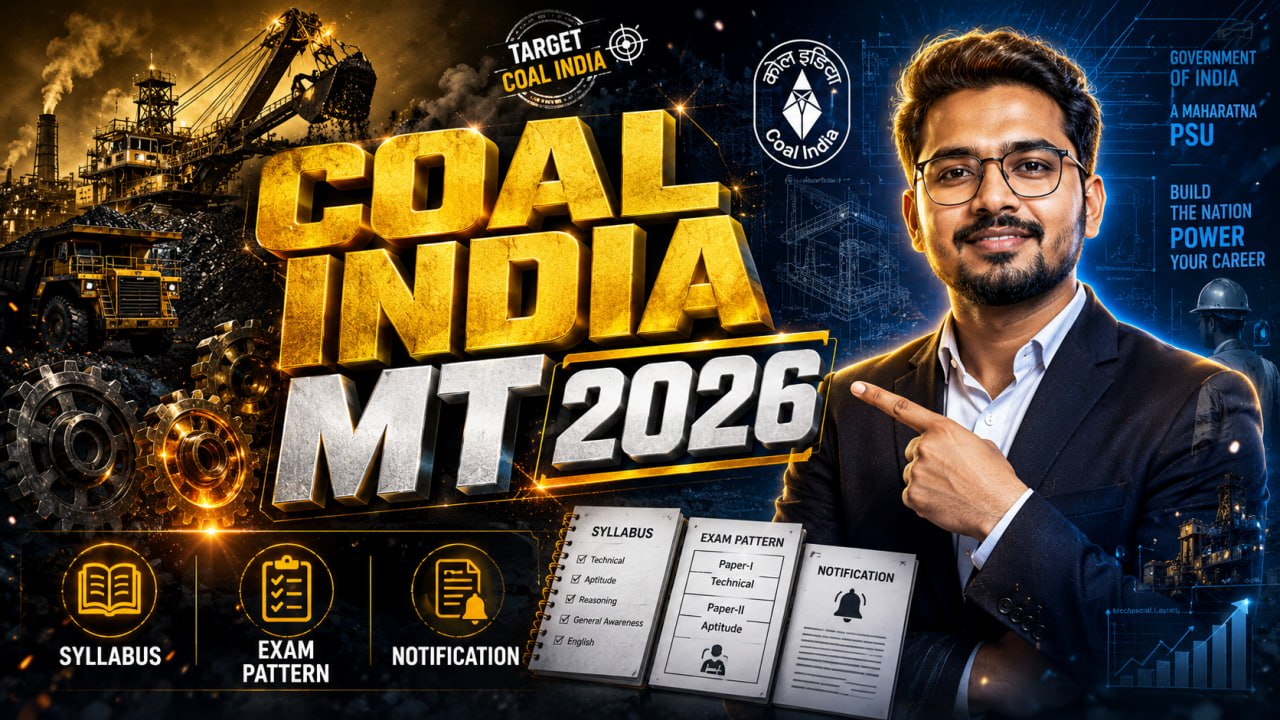
Coal India Limited (CIL) – India's Maharatna PSU and the world's single largest coal producer – has officially released Advertisement No. 03/2026, announcing 660 Management Trainee (MT) vacancies across 9 disciplines. With a starting pay scale of ₹60,000–₹1,80,000 per month in E-1 grade, excellent job security, and a completely interview-free selection process, CIL MT 2026 is one of the most sought-after PSU opportunities of the year for engineering and postgraduate candidates alike.
This blog is your complete, one-stop guide covering: official notification highlights, discipline-wise vacancies, eligibility criteria, detailed exam pattern, full subject-wise syllabus (based on official documents – with a note on updates), and a proven preparation strategy. The syllabus data for Paper II is sourced from the official CIL MT Mechanical Engineering syllabus (2019 version) and will be updated here as CIL releases the 2026 official syllabus PDF.
| Parameter | Details |
|---|---|
| Recruiting Organization | Coal India Limited (CIL) |
| Advertisement Number | 03/2026 (dated 05.05.2026) |
| Post Name | Management Trainee (MT) |
| Grade | E-1 Grade |
| Total Vacancies | 660 (647 Fresh + 13 Backlog) |
| Notification Release Date | 6th May 2026 |
| Application Start Date | 12th May 2026 (10:00 AM onwards) |
| Last Date to Apply | 11th June 2026 (up to 6:00 PM) |
| Mode of Application | Online only – www.coalindia.in |
| Selection Process | CBT → Document Verification → Medical Examination |
| Pay Scale (E-1 Grade) | ₹60,000 – ₹1,80,000 per month (Basic Pay ₹60,000 during training) |
| Interview | NO – Selection is based purely on CBT marks |
| Official Website | www.coalindia.in |
The 660 vacancies are spread across 9 disciplines covering engineering, geology, language, and administrative roles. Among all disciplines, Electrical Engineering carries the highest number of posts. Additionally, 64 posts are reserved on a horizontal basis for Persons with Benchmark Disabilities (PwBD).
| S.No | Discipline | Post Code | Eligibility Branch | Qualification | Min. Marks | Remarks |
|---|---|---|---|---|---|---|
| 1 | Civil Engineering | 11 | Civil | B.E./B.Tech | 60% | Highest demand |
| 2 | Electrical Engineering | 12 | Electrical/Electrical & Electronics | B.E./B.Tech | 60% | Most vacancies |
| 3 | Mechanical Engineering | 13 | Mechanical | B.E./B.Tech | 60% | High competition |
| 4 | System (CS/IT) | 14 | CS/Computer Engg./IT or MCA | B.E./B.Tech/MCA | 60% | 1st Class required |
| 5 | Electronics & Telecom. | 15 | Electronics/E&C/Telecom. | B.E./B.Tech | 60% | – |
| 6 | Geology | 16 | Geology/Applied Geology/Geophysics | M.Sc./M.Tech | 60% | PG required |
| 7 | Industrial Engineering | 17 | Industrial/Production Engg. | B.E./B.Tech | 60% | – |
| 8 | Rajbhasha (Hindi) | 18 | Hindi (MA) | MA in Hindi + Graduation | 60% | Language role |
| 9 | Company Secretary | 19 | Any Graduation | Graduation + ICSI (ACS/FCS) | – | Professional cert. required |
| GRAND TOTAL (including 64 PwBD posts on horizontal basis) | 660 | |||||
Disclaimer: Post-code references above are indicative based on previous CIL MT recruitment cycles and publicly available information. Exact post codes for 2026 will be confirmed in the official notification PDF at www.coalindia.in.
| Category | Maximum Age Limit |
|---|---|
| General / EWS | 30 years |
| OBC (Non-Creamy Layer) | 33 years (30 + 3 years relaxation) |
| SC / ST | 35 years (30 + 5 years relaxation) |
| PwBD – General/EWS | 40 years (30 + 10 years relaxation) |
| PwBD – OBC | 43 years (30 + 13 years relaxation) |
| PwBD – SC/ST | 45 years (30 + 15 years relaxation) |
| Ex-Servicemen | As per Government of India rules |
| CIL / Subsidiary Employees | No upper age limit |
| Discipline | Required Qualification |
|---|---|
| Civil / Electrical / Mechanical / Industrial Engg. | Full-time B.E./B.Tech/B.Sc (Engg.) in relevant branch with minimum 60% marks (55% for SC/ST/PwBD) |
| System (CS/IT) | 1st Class (60%) degree in BE/B.Tech/B.Sc (Engg.) in CS/Computer Engg./IT OR 1st Class degree in any stream + MCA |
| Electronics & Telecom. | Full-time B.E./B.Tech/B.Sc (Engg.) in Electronics/Telecom./E&C with minimum 60% marks |
| Geology | Full-time M.Sc. or M.Tech in Geology/Applied Geology/Geophysics with minimum 60% marks |
| Rajbhasha (Hindi) | MA in Hindi with minimum 60% marks + Graduation with Hindi & English as main subjects (minimum 50% marks) |
| Company Secretary | Graduation in any discipline from a recognized university + Associate/Fellow membership of ICSI |
| Category | Application Fee |
|---|---|
| General / OBC (Creamy Layer) / OBC (Non-Creamy Layer) / EWS | ₹1,000 + ₹180 GST = ₹1,180 (Non-Refundable) |
| SC / ST / PwBD / Employees of CIL & its Subsidiaries | NIL – Fully Exempted |
| Mode of Payment | Online only (Net Banking, Credit Card, Debit Card, UPI) |
The fee is strictly non-refundable under all circumstances. Candidates can apply for ONLY ONE discipline. Choose your discipline carefully – no changes or corrections are permitted after submission.
The CIL MT 2026 selection is entirely CBT-based. There is NO Group Discussion, NO Personal Interview, and NO Physical Test. The three-stage process is:
Since Paper I and Paper II each carry 100 marks (total 200 marks) and final selection is purely on CBT scores, your performance in Paper II (Professional Knowledge) is typically the decisive factor for engineering candidates.
The CBT is held in a single 3-hour sitting with two papers assessed simultaneously. Below is the complete exam pattern:
| Paper | Subject | Questions | Marks | Duration | Language |
|---|---|---|---|---|---|
| Paper I | General Aptitude: GK/Awareness, Reasoning, Numerical Ability, General English | 100 MCQs | 100 | 3 Hours (Combined) | Bilingual |
| Paper II | Professional Knowledge (Discipline-Specific) | 100 MCQs | 100 | Bilingual* | |
| TOTAL | 200 MCQs | 200 Marks | 3 Hours Total | ||
*Bilingual (English & Hindi) for all sections except General English (English only). In case of any discrepancy between Hindi and English versions, the English version shall be final and binding.
| Scenario | Marks Awarded |
|---|---|
| Correct Answer | +1 Mark per question |
| Wrong Answer | 0 (No Negative Marking) |
| Unattempted / Skipped | 0 Marks |
| Category | Paper I (Min. Marks / 100) | Paper II (Min. Marks / 100) |
|---|---|---|
| UR / EWS | 40 Marks | 40 Marks |
| OBC (Non-Creamy Layer) | 35 Marks | 35 Marks |
| SC / ST / PwBD | 30 Marks | 30 Marks |
Candidates failing to score the minimum qualifying marks in either paper will be disqualified from the merit list, regardless of their total combined score.
Paper I is COMMON for all disciplines. It tests four core areas as detailed below:
| 1. History of India | 9. Scientific Research & Inventions |
| 2. Indian Geography | 10. Culture, Art & Sports |
| 3. Indian Constitution & Polity | 11. Countries & Capitals |
| 4. Economy, Banking & Finance | 12. Important Financial & Economic News |
| 5. Budget & Five Year Plans / Government Schemes | 13. General Politics |
| 6. Current Affairs – National & International | 14. India & Neighbouring Countries |
| 7. Knowledge of Current Events | 15. Coal Industry, Energy Sector & CIL Facts |
| 8. Science – General Awareness | 16. Environment & Ecology Basics |
| 1. Simplification & Approximation | 9. Data Interpretation (Tables, Pie, Bar, Line Charts) |
| 2. Profit & Loss | 10. Ratio & Proportion |
| 3. Time, Speed & Distance | 11. Percentage |
| 4. Time & Work / Pipes & Cisterns | 12. Number Systems |
| 5. Problems on Ages | 13. Permutation, Combination & Probability |
| 6. Averages | 14. Mensuration (Cylinder, Cone, Sphere) |
| 7. Boats & Streams | 15. Simple & Compound Interest |
| 8. Series & Sequences | 16. Mixtures & Alligations |
| 1. Seating Arrangement (Circular & Linear) | 9. Syllogism |
| 2. Puzzle Tabulation | 10. Input-Output |
| 3. Alphanumeric Series | 11. Coded Inequalities |
| 4. Coding-Decoding | 12. Data Sufficiency |
| 5. Blood Relations | 13. Ranking / Direction / Alphabet Test |
| 6. Logical Reasoning | 14. Figure Classification & Non-Verbal Reasoning |
| 7. Space Visualisation & Visual Memory | 15. Decision Making |
| 8. Arithmetical Number Series | 16. Discriminating Observation & Similarities |
| 1. Reading Comprehension (Unseen Passages) | 8. Word Formation & Vocabulary |
| 2. Error Correction / Error Spotting | 9. Synonyms & Antonyms |
| 3. Sentence Rearrangement (Para-Jumbles) | 10. Idioms & Phrases |
| 4. Fill in the Blanks | 11. Theme Detection |
| 5. Sentence Completion | 12. Passage Completion |
| 6. Tenses & Grammar Rules | 13. Subject-Verb Agreement |
| 7. Articles, Adverbs & Verbs | 14. Conclusion-based Questions |
Paper II tests Professional Knowledge specific to the candidate's chosen discipline. The Mechanical Engineering syllabus below is based on the official CIL MT Mechanical Syllabus document. This blog will be updated immediately when CIL releases the 2026 syllabus PDF – always verify with the official notification.
| Subject | Key Topics Covered |
|---|---|
| Engineering Mechanics | Free-body diagrams and equilibrium; trusses and frames; virtual work; kinematics and dynamics of particles and rigid bodies in plane motion; impulse and momentum (linear and angular); energy formulations; collisions |
| Mechanics of Materials | Stress and strain; elastic constants; Poisson's ratio; Mohr's circle for plane stress and strain; thin cylinders; SFD and BMD; bending and shear stresses; deflection of beams; torsion of circular shafts; Euler's theory of columns; energy methods; thermal stresses; strain gauges and rosettes; testing with UTM; hardness and impact strength testing |
| Theory of Machines | Displacement, velocity and acceleration analysis of plane mechanisms; dynamic analysis of linkages; cams; gears and gear trains; flywheels and governors; balancing of reciprocating and rotating masses; gyroscope |
| Vibrations | Free and forced vibration of single degree of freedom systems; effect of damping; vibration isolation; resonance; critical speeds of shafts |
| Machine Design | Design for static and dynamic loading; failure theories; fatigue strength and S-N diagram; design of bolted, riveted and welded joints; shafts; gears; rolling and sliding contact bearings; brakes and clutches; springs |
| Fluid Mechanics | Fluid properties; fluid statics; manometry; buoyancy; forces on submerged bodies; stability of floating bodies; control-volume analysis; Bernoulli's equation; dimensional analysis; viscous flow; boundary layer; elementary turbulent flow; flow through pipes; head losses in pipes, bends and fittings |
| Heat Transfer | Modes of heat transfer; 1D heat conduction; resistance concept; heat transfer through fins; unsteady conduction (lumped parameter system, Heisler's charts); thermal boundary layer; convection correlations for flat plates and pipes; effect of turbulence; heat exchanger performance (LMTD and NTU methods); radiation: Stefan-Boltzmann law, Wien's displacement law, black and grey surfaces, view factors, radiation network analysis |
| Thermodynamics | Thermodynamic systems and processes; properties of pure substances; ideal and real gas behaviour; zeroth, first and second laws of thermodynamics; calculation of work and heat in various processes; thermodynamic property charts and tables; availability and irreversibility; thermodynamic relations |
| Power Engineering & IC Engines | Air and gas compressors; vapour and gas power cycles; regeneration and reheat; IC Engines: air-standard Otto, Diesel and dual cycles |
| Refrigeration, AC & Turbomachinery | Vapour and gas refrigeration and heat pump cycles; properties of moist air; psychrometric chart; basic psychrometric processes; impulse and reaction principles; velocity diagrams; Pelton-wheel, Francis and Kaplan turbines |
| Engineering Materials | Structure and properties of engineering materials; phase diagrams; heat treatment; stress-strain diagrams for engineering materials |
| Casting, Forming & Joining | Types of castings; design of patterns, moulds and cores; solidification and cooling; riser and gating design; plastic deformation and yield criteria; hot and cold working; load estimation for bulk and sheet metal forming (forging, rolling, extrusion, drawing, shearing, deep drawing, bending); powder metallurgy; welding, brazing, soldering and adhesive bonding |
| Machining & Machine Tools | Mechanics of machining; basic machine tools; single and multi-point cutting tools; tool geometry and materials; tool life and wear; economics of machining; non-traditional machining; principles of work holding; design of jigs and fixtures |
| Metrology & Inspection | Limits, fits and tolerances; linear and angular measurements; comparators; gauge design; interferometry; form and finish measurement; alignment and testing methods; tolerance analysis in manufacturing and assembly |
| CAD/CAM & CIM | Basic concepts of CAD/CAM and their integration tools; Computer Integrated Manufacturing fundamentals |
| Production Planning & Control | Forecasting models; aggregate production planning; scheduling; Materials Requirement Planning (MRP) |
| Inventory Control | Deterministic models (EOQ, reorder point); safety stock; inventory control systems |
| Operations Research | Linear programming (Simplex method); transportation and assignment problems; network flow models; simple queuing models; PERT and CPM |
| Discipline | Core Areas in Paper II |
|---|---|
| Civil Engineering | Structural Analysis, Concrete & Steel Structures (IS Codes), Geotechnical Engineering, Fluid Mechanics & Hydraulics, Transportation Engineering, Environmental Engineering, Surveying & Geodesy, Construction Materials & Management |
| Electrical Engineering | Electric Circuits & Fields, Electrical Machines (DC, AC, Transformers), Power Systems (generation, transmission, protection), Control Systems, Analog & Digital Electronics, Measurements & Instrumentation, Power Electronics & Drives |
| System (CS/IT) | DBMS (ER Diagrams, Normalization, SQL), Operating Systems, Data Structures & Algorithms, Computer Networks (OSI, TCP/IP, Protocols), Software Engineering, Digital Logic & Computer Architecture, Cloud Computing basics, Cybersecurity fundamentals |
| Electronics & Telecom. | Analog Circuits, Digital Circuits & Logic Design, Signals & Systems, Communications (Analog & Digital), Electromagnetic Theory, Microprocessors & Microcontrollers, VLSI Design basics, Control Systems |
| Geology | Physical Geology, Petrology, Mineralogy, Structural Geology, Stratigraphy, Economic Geology, Coal Geology, Hydrogeology, Geophysical Methods, Remote Sensing & GIS basics |
| Industrial Engineering | Work Study & Method Study, Operations Research, Production Planning & Control, Quality Management (TQM, SPC), Facility Planning & Layout, Ergonomics, Supply Chain Management, Project Management |
| Rajbhasha (Hindi) | Hindi Grammar & Literature, Official Language Policy (Rajbhasha), Translation (Hindi-English & vice versa), Rajbhasha Rules & Acts, Official Correspondence in Hindi, Hindi Terminology |
| Company Secretary | Company Law (Companies Act 2013), Securities Law (SEBI), Corporate Governance, Economic & Commercial Laws, Tax Laws (Direct & Indirect), Financial & Strategic Management, Industrial & Labour Laws, ICSI Framework |
| Component | Details |
|---|---|
| Pay Scale | E-1 Grade: ₹60,000 – ₹1,80,000 per month |
| Basic Pay (During Training) | ₹60,000 per month (fixed initial basic pay for 1-year training period) |
| Dearness Allowance (DA) | As per CIL / Government rules; revised periodically |
| House Rent Allowance (HRA) | As per city classification; company-provided accommodation available at many coalfield locations |
| Performance Related Pay (PRP) | Variable pay linked to individual and company performance post-training |
| Perquisites (Cafeteria Approach) | Choose from a basket of allowances including transport, children education, LTC, etc. |
| Provident Fund | CMPF (Coal Mines Provident Fund) |
| Pension | CMPS (Coal Mines Pension Scheme) + CIL Executive Defined Contribution Pension Scheme |
| Gratuity | As per Payment of Gratuity Act, 1972 |
| Medical Facilities | Comprehensive medical coverage for employee and dependant family members |
| Leave Benefits | Earned Leave, Casual Leave, Sick Leave, LTC as per CIL service rules |
| Service Bond | ₹3 Lakh bond executed at joining; ₹5,000 deducted monthly from salary; full amount refunded WITHOUT interest after 60 months (5 years) of continuous service |
| Posting Location | Pan-India; primarily at coalfield locations under CIL subsidiary companies (BCCL, CCL, MCL, NCL, SECL, WCL, ECL, CMPDIL) |
No offline/postal applications are accepted under any circumstances. Only ONE application per candidate is allowed. Submitting multiple applications may lead to disqualification.
| Subject | Recommended Reference Books / Resources |
|---|---|
| Quantitative Aptitude | R.S. Aggarwal – Quantitative Aptitude for Competitive Examinations; M. Tyra – Magical Book on Quicker Maths |
| Reasoning | R.S. Aggarwal – A Modern Approach to Verbal & Non-Verbal Reasoning |
| General English | Wren & Martin – High School English Grammar; Arihant – Objective General English by SP Bakshi |
| General Awareness / Current Affairs | Manorama Yearbook; Lucent General Knowledge; AffairsCloud / GKToday Monthly PDF; Pratiyogita Darpan |
| Thermodynamics (Mech.) | P.K. Nag – Engineering Thermodynamics |
| Fluid Mechanics (Mech.) | R.K. Bansal – A Textbook of Fluid Mechanics and Hydraulic Machines |
| Theory of Machines (Mech.) | S.S. Rattan – Theory of Machines; R.S. Khurmi – Theory of Machines |
| Production / Manufacturing (Mech.) | P.C. Sharma – A Textbook of Production Engineering; Kalpakjian – Manufacturing Engineering & Technology |
| General Mech. Engg. (GATE level) | Made Easy / IES Master GATE Study Materials for Mechanical Engineering; GK Publications GATE Guide |
| Previous Year Papers | CIL MT Previous Year Papers (available on official website); GATE Previous Papers for Paper II topics (multiple publishers) |
Coal India MT 2026 represents a rare combination of brand value (Maharatna PSU), job stability, excellent pay (₹60,000 starting basic), and an interview-free, transparent selection process. With 660 vacancies across 9 disciplines and an application window from 12th May to 11th June 2026, here is your immediate action plan:
Note to Readers: The syllabus information in this blog is primarily based on the official CIL MT Mechanical Engineering Syllabus document (2019 version) and cross-verified with 2026 notification details. If CIL releases an updated or revised syllabus PDF for 2026, this blog will be updated immediately. Candidates must always treat the official notification PDF as the final and binding authority on syllabus, exam pattern, vacancies, and eligibility. Bookmark this page and check back regularly for the latest updates.
Best of Luck for CIL MT 2026! Prepare Smart. Stay Consistent. Crack the Exam.
Official Website: www.coalindia.in | Advt. No.: 03/2026 | Apply: 12 May – 11 June 2026
Makeiteasy

“Download our app now to unlock a world of convenience and seamless access to our extensive range of features, including live and recorded classes, study material, Test series and thousand of practice questions—all at your fingertips!”


Leave a Comment