

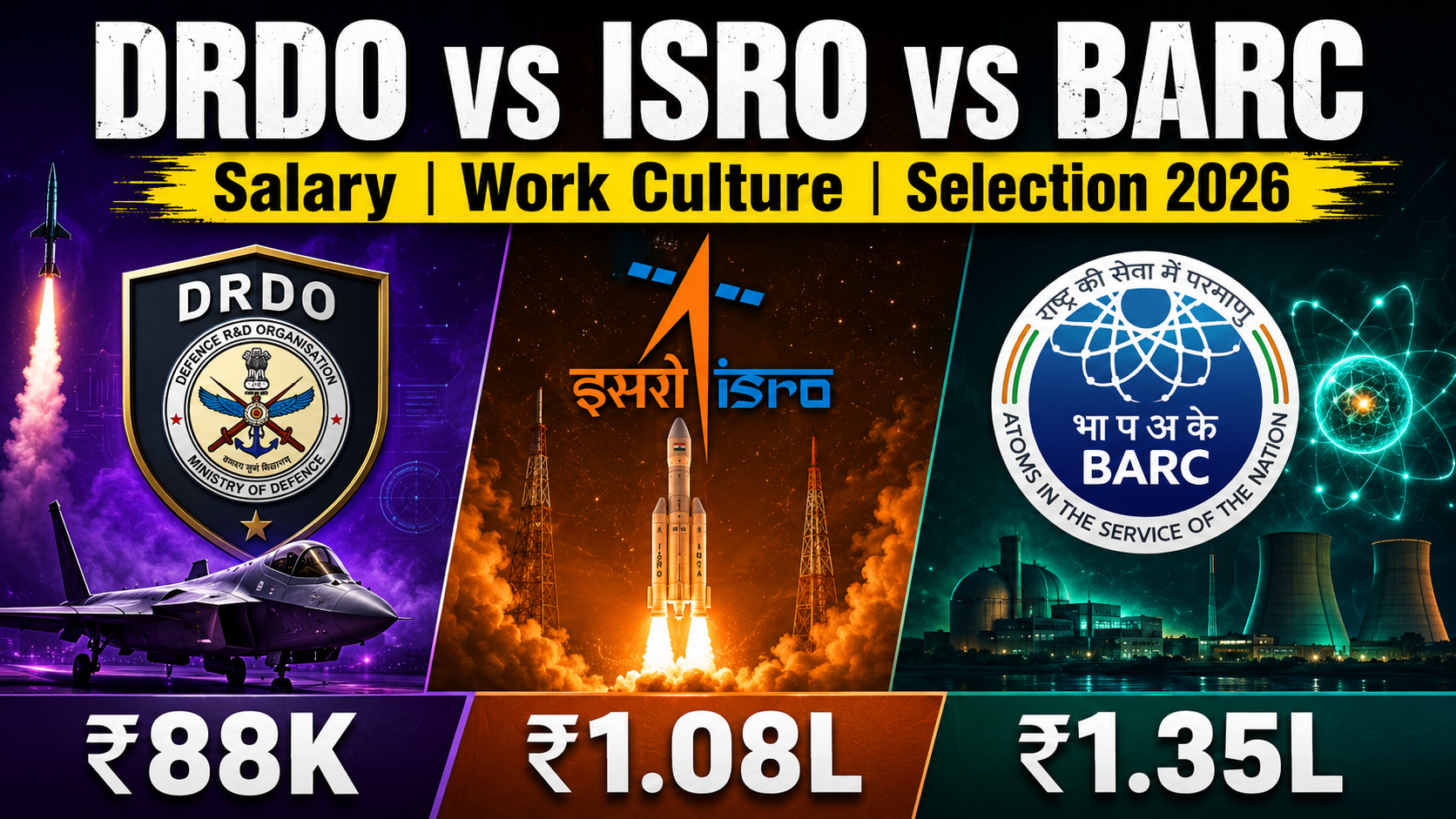
Every year, lakhs of engineering graduates and science postgraduates dream of one thing: landing a job at one of India's prestigious government research organisations. The debate between DRDO, ISRO, and BARC is one of the most heated in competitive exam circles - and rightfully so. All three offer stellar salaries, rock-solid job security, and the rare opportunity to work on projects that shape the nation's future.
But here's the thing - they are vastly different in terms of work culture, selection methodology, career trajectory, and day-to-day life. Choosing the wrong one for your temperament and goals can lead to years of professional dissatisfaction, even if the paycheck looks great.
This guide cuts through the noise. We have compiled verified salary data from official 7th Pay Commission structures, cross-referenced with 2026 recruitment notifications from DRDO RAC, ISRO URSC, and BARC OCES/DGFS programmes - so every number you see here is accurate and current.
Before diving into numbers, it helps to understand what each organisation actually does and where it sits within the Government of India's research ecosystem.
Under the Ministry of Defence. 50+ laboratories across India. Focused on advanced weapons, aerospace, electronics, materials, and cyber defence for the Indian Armed Forces.
Under the Department of Space. 13 major centres across India. Focused on satellite development, launch vehicles (PSLV, GSLV, LVM3), planetary exploration (Chandrayaan, Mangalyaan), and space applications.
Under the Department of Atomic Energy. Primary centre in Mumbai (Trombay). Focused on nuclear energy, reactor technology, radioisotopes, radiation safety, and advanced materials science.
| Parameter | DRDO | ISRO | BARC |
|---|---|---|---|
| Founded | 1958 | 1969 | 1954 |
| Ministry/Department | Ministry of Defence | Department of Space | Department of Atomic Energy |
| HQ | New Delhi | Bengaluru | Mumbai (Trombay) |
| No. of Labs/Centres | 50+ Labs | 13 Major Centres | 8+ DAE Units |
| Total Employees (approx.) | ~30,000 | ~16,000 | ~6,500+ |
| Primary Focus | Defence Technology | Space Technology | Nuclear Science & Energy |
| Entry Post Name | Scientist B | Scientist/Engineer SC | Scientific Officer (Level 10) |
| Governing Pay Commission | 7th CPC | 7th CPC | 7th CPC |
| Classified Work? | Yes (defence) | Partially | Yes (nuclear) |
All three organisations follow the 7th Central Pay Commission (7th CPC) pay matrix. Entry-level scientists in all three are placed at Pay Level 10 with a basic pay of ₹56,100. However, the total in-hand salary differs significantly because of varying allowances — and BARC's higher-cost Mumbai posting tips the scales considerably.
DRDO scientists are recruited primarily through the RAC (Recruitment and Assessment Centre) based on GATE scores and/or a written exam followed by a personal interview. The Scientist B post sits at Pay Level 10.
| DRDO Pay Component | Amount (per month) |
|---|---|
| Basic Pay (Level 10) | ₹56,100 |
| Dearness Allowance (DA) @ ~53% of Basic | ~₹29,733 |
| House Rent Allowance (HRA) — X City | ~₹13,464 (24% of Basic) |
| Transport Allowance (TA) + DA on TA | ₹3,600 – ₹7,200 |
| Professional Update Allowance | ₹22,500 (annual, ~₹1,875/mo) |
| Estimated Gross (metro posting) | ~₹88,000 – ₹1,00,000 |
| Deductions (PF, CGEIS, CGHS, Income Tax) | ~₹8,000 – ₹14,000 |
| Approx. In-Hand Salary | ₹75,000 – ₹88,000 |
ISRO recruits Scientist/Engineers at the SC grade - the entry level. The progression goes SC → SD → SE → SF → SG → Outstanding Scientist → Distinguished Scientist. Fresh recruits join at Level 10 and face a probation period of 1 year.
| ISRO Pay Component | Amount (per month) |
|---|---|
| Basic Pay (Level 10) | ₹56,100 |
| Industrial Dearness Allowance (IDA) | ~₹33,660 (@ 60% of Basic, revised 2026) |
| House Rent Allowance (HRA) — metro | ~₹13,464 (24% of Basic) |
| Transport Allowance | ₹500 – ₹3,500/month |
| Other Special Allowances | ~₹3,000 – ₹5,000 |
| Approx. Gross (metro posting) | ~₹1,00,000 – ₹1,08,000 |
| Deductions | ~₹8,000 – ₹12,000 |
| Net In-Hand Salary | ₹95,059 – ₹1,07,635 |
BARC stands out because of its unique training model. Before being confirmed as Scientific Officers, candidates go through a one-year OCES training (or two-year DGFS M.Tech fellowship). During training, they receive a generous stipend - and post-confirmation, the total emoluments in Mumbai are the highest of the three organisations at this entry level.
| BARC Pay Component | During Training (TSO) | After Appointment (Sci. Officer) |
|---|---|---|
| Basic Pay / Stipend | ₹74,000/month (stipend) | ₹56,100 (Level 10) |
| Book Allowance (one-time, OCES) | ₹30,000 | — |
| DA | Not applicable (stipend) | ~₹29,733 |
| HRA (Mumbai — 24% of Basic) | Included in stipend | ~₹13,464 |
| Transport & Other Allowances | Included | ~₹5,000 – ₹8,000 |
| Professional Update Allowance | — | ~₹1,875/mo |
| Total Monthly Emoluments | ₹74,000 (stipend) | ~₹1,35,000 (Mumbai) |
| Benefit / Allowance | DRDO | ISRO | BARC |
|---|---|---|---|
| Dearness Allowance (DA) | ~53% of Basic (CG DA) | ~60% of Basic (IDA) | ~53% of Basic (CG DA) |
| House Rent Allowance (HRA) | 8% / 16% / 24% of Basic | 10% – 30% of Basic | 8% / 16% / 24% of Basic |
| Professional Update Allowance | ₹22,500/year | Available | Available |
| Medical Benefits | CGHS + DRDO dispensary | ISRO Medical Facility | Full DAE medical facilities |
| Government Accommodation | Yes (at many labs) | Yes (at centres) | Yes (BARC colony, Mumbai) |
| Higher Education / Sabbatical | Partial | Yes (PhD support) | Very robust (HBNI University) |
This is where the three organisations differ most dramatically. Understanding each recruitment pathway is crucial for targeted preparation.
DRDO recruits Scientist B primarily through its Recruitment and Assessment Centre (RAC). The process is competitive but straightforward for GATE candidates.
ISRO's recruitment for Scientist/Engineer SC typically happens once or twice a year through individual centre notifications or a centralised ISRO Centralised Recruitment Board (ICRB) process.
BARC's selection model is the most unique of the three. It is not a simple exam-and-interview — it is a training programme with a bond commitment.
| Criteria | DRDO (Scientist B) | ISRO (Scientist SC) | BARC (OCES/DGFS) |
|---|---|---|---|
| Qualification | B.E./B.Tech or M.Sc. | B.E./B.Tech or M.Sc./M.Tech | B.E./B.Tech or M.Sc. |
| Minimum Marks | 60% or equivalent CGPA | 65% or 6.84 CGPA | 60% or 6.0 CGPA |
| GATE Required? | Yes (for shortlisting) | No (written test instead) | Optional (GATE OR BARC exam) |
| Age Limit (General) | 28 years | 35 years | 26 years (OCES) / 28 (DGFS) |
DRDO's work environment varies dramatically depending on which of its 50+ laboratories you are posted at. You get a wide geographic presence and diverse technical domains, but bureaucratic processes can slow project timelines, and security clearance can restrict personal freedom.
ISRO is widely regarded as having the most mission-driven culture of the three. Working hours are flexible but intense around launch windows. Meritocracy is key, and young scientists can take ownership of critical systems.
BARC offers arguably the most structured and self-contained work environment. The Trombay campus in Mumbai functions almost like a small city. You get a strict Monday to Friday schedule with excellent work-life balance.
There is no objectively "best" option here. Each organisation caters to a different professional personality. Here's our honest, data-backed verdict:
Choose BARC if you want the highest entry-level in-hand salary, a 5-day work week, excellent work-life balance, and the chance to work at the frontier of nuclear science. Be prepared for a rigorous interview and a 3-year service bond.
Choose ISRO if you are passionate about space, crave a mission-driven culture, and want to work on projects that make national and global headlines. Be ready for intense work phases around launch windows.
Choose DRDO if you have a specific interest in defence technology, want maximum geographic flexibility, or are comfortable working across diverse technical domains. DRDO also recruits the most — making it the most accessible of the three.
Start building your GATE score today - it opens doors to all three organisations.
Makeiteasy









“Download our app now to unlock a world of convenience and seamless access to our extensive range of features, including live and recorded classes, study material, Test series and thousand of practice questions—all at your fingertips!”


Leave a Comment