

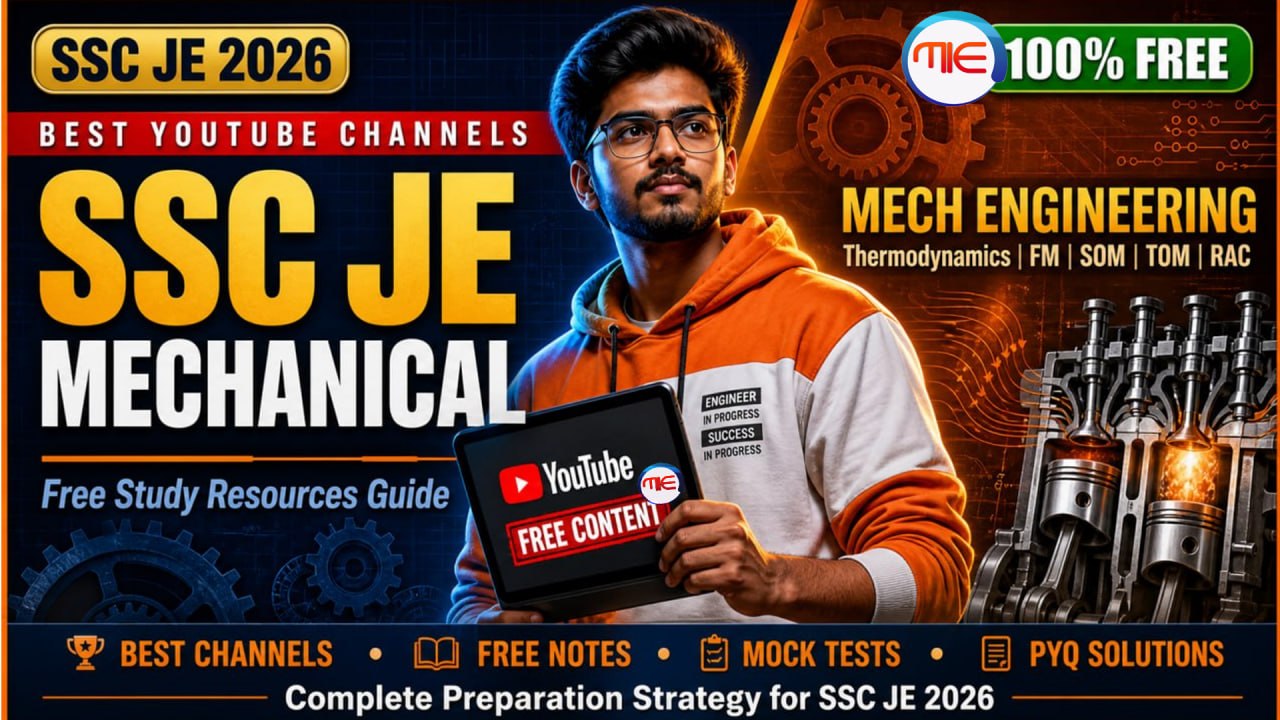
The SSC Junior Engineer (SSC JE) exam is one of India's most sought-after government engineering recruitment exams, conducted annually by the Staff Selection Commission. With central government departments like CPWD, BRO, and MES hiring through this exam, competition is fierce — and your choice of study resource can literally make or break your selection.
For SSC JE Mechanical 2026, the exam is expected to be conducted in May–June 2026 for Paper I, and notifications are anticipated around March–April 2026. With lakhs of aspirants targeting the same seats, the question is: where do you study, and who do you learn from?
In 2025, the Tier 1 Cut Off for Electrical/Mechanical Engineering (General Category) stood at 127.30 marks out of 200. That leaves very little room for error. You need structured, concept-driven, and exam-oriented preparation — and the right YouTube channel can give you exactly that, often for free.
This guide walks you through everything - the exam pattern, syllabus, cut-off trends, and most importantly, the best YouTube channel to trust for your SSC JE Mechanical 2026 preparation.
Before diving into preparation resources, understand the battlefield.
| Parameter | Details |
|---|---|
| Conducting Body | Staff Selection Commission (SSC) |
| Post Name | Junior Engineer (Mechanical) |
| Departments | CPWD, BRO, MES, CWC, BSNL, Railways |
| Notification Expected | March–April 2026 |
| Paper I Exam Date | May–June 2026 |
| Eligibility | Diploma/Degree in Mechanical Engineering |
| Age Limit | 18–32 years (with category relaxation) |
| Application Fee | ₹100 (General); Nil for SC/ST/PwD/Women |
| Selection Process | Paper I → Paper II → Document Verification |
| Starting Salary | ₹35,400/- per month (Level 6, 7th Pay Commission) |
| In-Hand Salary | Approx. ₹50,000–₹55,000/month (with DA, HRA, TA) |
The exam has two stages - Paper I and Paper II. Both are Computer-Based Tests (CBT) as of the 2023 pattern onwards.
| Section | Questions | Marks | Duration |
|---|---|---|---|
| General Intelligence & Reasoning | 50 | 50 | - |
| General Awareness | 50 | 50 | - |
| General Engineering (Mechanical) | 100 | 100 | - |
| Total | 200 | 200 | 2 Hours |
Negative Marking: 0.25 marks per wrong answer in Paper I.
| Component | Questions | Marks | Duration |
|---|---|---|---|
| Mechanical Engineering (Part C) | 100 | 300 (3 marks each) | 2 Hours |
Negative Marking: 1 mark per wrong answer in Paper II.
The level of questions is based on Diploma/Degree standards from a recognized institution.
| Topic Area | Key Subtopics |
|---|---|
| Theory of Machines | Gear trains, flywheels, governors, kinematics |
| Engineering Mechanics | Force systems, friction, virtual work |
| Strength of Materials | Stress-strain, bending moment, torsion |
| Thermal Engineering | Laws of thermodynamics, IC engines, steam |
| Fluid Mechanics | Bernoulli's equation, flow types, pumps, turbines |
| Manufacturing & Production | Casting, welding, machining, metrology |
| Machine Design | Design of shafts, keys, couplings, springs |
| Workshop Technology | Lathe, drilling, milling operations |
| Subject | Important Topics |
|---|---|
| Theory of Machines & Machine Design | Velocity/acceleration analysis, CAM, gear design |
| Engineering Mechanics & Strength of Materials | Columns, springs, thin cylinders, deflection |
| Thermal Engineering | Rankine cycle, refrigeration, air standard cycles |
| Fluid Mechanics & Machinery | Hydraulic turbines, centrifugal pumps, compressors |
| Production Engineering | Metal cutting theory, CNC, jigs and fixtures |
Series, analogies, coding-decoding, blood relations, Venn diagrams, number matrix, direction and distance, seating arrangement, and puzzle-based questions.
History, Geography, Economy, Polity, Current Affairs, Science, Sports, Books and Authors, Awards and Honors.
Understanding historical cut-offs helps set a realistic preparation target.
| Year | General (UR) | OBC | EWS | SC | ST |
|---|---|---|---|---|---|
| 2025 (Released Mar 2026) | 127.30 | - | - | - | - |
| 2024 | 132.06 | 131.27 | 120.13 | - | - |
| 2023 | ~128–133 | ~126–130 | ~118–122 | ~110–115 | ~95–105 |
| 2022 | ~130–135 | ~128–132 | ~119–124 | ~110–118 | ~96–108 |
| Category | Expected Cut-Off (Electrical/Mechanical Paper I) |
|---|---|
| General (UR) | 125–132 |
| OBC | 122–130 |
| EWS | 118–125 |
| SC | 110–118 |
| ST | 96–108 |
*Expected figures based on previous year trends. Final cut-off depends on vacancies, difficulty level, and normalization.
Most aspirants make the mistake of relying on general engineering study materials - textbooks, random PDFs, or coaching notes that aren't tailored to the SSC JE pattern. The result? They end up over-preparing irrelevant topics and under-preparing the high-weightage ones.
SSC JE Mechanical is a specific exam with a specific pattern. About 90% of Paper I questions are theory-based, with only 10% basic numericals. Paper II, while deeper, still rewards candidates who understand concepts clearly rather than those who memorize formulas blindly.
What you need is a teacher and a platform that:
When it comes to SSC JE Mechanical preparation on YouTube, Make It Easy is a name that stands apart in the community of serious aspirants. The channel, anchored by Rahul Kothiyal Sir, has become one of the most trusted free resources for Mechanical Engineering competitive exam preparation.
Make It Easy (MIE) was created specifically for mechanical engineering aspirants targeting exams like SSC JE, RRB JE, NHPC, UPSSSC, DSSSB, BARC, ISRO, DRDO, NCL, NTPC, and all State-level AE/JE exams. The channel's philosophy is simple: make quality engineering education accessible to every aspirant, regardless of their financial background.
The channel link: youtube.com/@makeiteasybyrahulsir
Rahul Kothiyal Sir is a dedicated mechanical engineering educator who has built his entire teaching methodology around competitive exam requirements. His strength lies in breaking down complex mechanical engineering concepts — thermodynamics, fluid mechanics, theory of machines — into simple, memorable explanations that are directly applicable in the exam hall.
What sets him apart is his deep understanding of the SSC JE Mechanical paper pattern, having guided thousands of students over the years through both free YouTube content and structured paid batches.
The channel covers the entire SSC JE Mechanical syllabus - both Paper I and Paper II - in a structured, topic-wise manner. From Theory of Machines to Fluid Mechanics, Strength of Materials to Thermal Engineering, Manufacturing Processes to Machine Design - nothing is left out.
Every lecture on Make It Easy is designed with the exam in mind. Rahul Sir explains which types of questions appear in SSC JE from each topic, what the weightage is, and how to approach both theory and numerical questions efficiently.
One of the standout features of the channel is its deep focus on SSC JE Previous Year Question Paper solutions. Whether it's Paper I MCQs or Paper II technical questions, the channel regularly uploads solved PYQ sessions that help aspirants understand exact question patterns.
After every SSC JE Paper I and Paper II exam, Make It Easy releases detailed shift-wise exam analysis videos — something extremely valuable for aspirants preparing for the next cycle. These videos reveal which topics were asked, the difficulty level, and what to focus on for Paper II.
Content on Make It Easy is not limited to SSC JE. If you're also targeting RRB JE, NHPC JE, UPSSSC JE, DSSSB, UKPSC JE, NCL JE, or any State AE/JE exam, the same preparation is highly applicable. The channel creates content covering all these exams, maximizing the return on your preparation time.
A significant portion of the channel's content is completely free. This means aspirants from any economic background can access quality mechanical engineering education without spending a rupee.
The channel and its associated platform have produced verified results across multiple batches:
| Student | Achievement |
|---|---|
| Rakesh Kumar Ray | Selected in NPCIL Narora as Stipendiary Trainee; also gave SSC JE Mains and ISRO IPRC Skill Test |
| Multiple Aspirants | SSC JE Pre cleared 3+ times, SSC JE Mains written, BRO selection achieved |
| Various Students | Selected in NPCIL, Scientific Assistant posts, and State JE exams |
These are real testimonials from real students - a strong indicator of the channel's effectiveness.
| Subject | Coverage on MIE YouTube |
|---|---|
| Theory of Machines | Complete - from basics to exam-level questions |
| Fluid Mechanics | In-depth theory + numericals + Hydraulic Machines |
| Thermal Engineering | IC Engines, Thermodynamics Laws, Air Standard Cycles |
| Strength of Materials | SOM basics, advanced numerical problems |
| Manufacturing & Production | Casting, welding, machining, metrology |
| Engineering Mechanics | Statics, dynamics, free body diagrams |
| Machine Design | Fatigue, design of shafts and keys |
| General Awareness | Current exam-specific updates |
| Reasoning | Shortcuts and practice sessions |
While the YouTube channel is the free backbone of preparation, Make It Easy also offers structured paid courses through its official platform for aspirants who want a more organized learning journey.
| Feature | Details |
|---|---|
| SSC JE Pre+Mains Recorded Batch | Complete syllabus coverage for both papers |
| LIVE MCQ Practice Sessions | Daily/weekly live practice for exam readiness |
| Test Series | Topic-wise and full-length mock tests |
| PDF Study Material | Concise revision notes for all subjects |
| Doubt Solving Sessions | Regular doubt-clearing for enrolled students |
| MAHAPACK for All JE Exams | Bundle covering SSC JE, RRB JE, State JE — all in one |
The platform also offers courses for RRB JE, NHPC, NCL, UKPSC JE, DDA JE, NPCIL, and other exams — making it a comprehensive hub for mechanical engineering competitive preparation.
Understanding where marks come from helps you prioritize intelligently.
| Subject | Approximate Weightage |
|---|---|
| Theory of Machines | 18–22% |
| Fluid Mechanics & Machinery | 18–22% |
| Thermal Engineering | 15–18% |
| Strength of Materials | 12–15% |
| Manufacturing & Production | 12–15% |
| Engineering Mechanics | 8–10% |
| Machine Design | 5–8% |
| Workshop/Miscellaneous | 3–5% |
| Subject | Approximate Weightage |
|---|---|
| Thermal Engineering | 20–25% |
| Fluid Mechanics & Machinery | 20–22% |
| Theory of Machines + Machine Design | 18–22% |
| Strength of Materials | 15–18% |
| Manufacturing & Production | 12–15% |
| Engineering Mechanics | 5–8% |
Here's a practical preparation roadmap if you're starting today (May 2026 exam target):
| Month | Focus Area |
|---|---|
| Month 1 | Engineering Mechanics + Strength of Materials (basics to advanced) |
| Month 2 | Theory of Machines + Machine Design |
| Month 3 | Fluid Mechanics + Hydraulic Machines |
| Month 4 | Thermal Engineering (Thermo Laws, IC Engines, Refrigeration) |
| Month 5 | Manufacturing & Production Engineering |
| Month 6 | Reasoning + General Awareness + Full Mock Tests + PYQ Revision |
Getting the most out of a free YouTube channel requires a structured approach. Here's what smart aspirants do:
Step 1 - Subscribe and Organize
Subscribe to the channel and create a subject-wise YouTube playlist for SSC JE Mechanical topics.
Step 2 - Follow Topic-Wise Playlists
The channel has organized playlists by subject. Follow them in sequence — don't jump randomly between topics.
Step 3 - Take Notes Actively
Don't just watch. Take handwritten or digital notes of formulas, important concepts, and shortcuts explained by Rahul Sir.
Step 4- Solve Along
When PYQ sessions are running, pause the video, attempt the question yourself, then watch the explanation. This active engagement significantly improves retention.
Step 5 - Attempt Chapter-Wise Tests
After completing each subject on the channel, take a mock test or solve previous year questions from that topic independently to test yourself.
Step 6 - Watch Exam Analysis Videos
Every time an SSC JE exam is conducted, watch the analysis videos on Make It Easy to understand trending topics and adjust your preparation accordingly.
Avoid these preparation pitfalls:
The SSC JE Mechanical 2026 exam is demanding - but it is absolutely crackable with the right strategy and the right resources. The competition is high, the cut-offs are rising, and the paper pattern demands both conceptual clarity and exam smartness.
What you need is a trusted learning source that teaches you the way the exam expects you to know — not the way a university textbook would. Make It Easy by Rahul Sir delivers exactly that: free, structured, exam-oriented Mechanical Engineering education built for aspirants just like you.
Start with the YouTube channel, follow the topic-wise approach, solve PYQs religiously, and back it up with consistent mock test practice. If you want more depth, the platform's paid courses offer complete hand-holding from Pre to Mains — but even the free content is more than enough to build a solid foundation.
The notification is expected in March–April 2026. The clock is ticking. Subscribe, start watching, and take your first step today — because consistency over the next few months is what separates those who get selected from those who don't.
Your government job in Mechanical Engineering is one focused preparation away. Make It Easy - and make it yours.
Makeiteasy

“Download our app now to unlock a world of convenience and seamless access to our extensive range of features, including live and recorded classes, study material, Test series and thousand of practice questions—all at your fingertips!”


Leave a Comment