

| Total Vacancies | Applicants (est.) | Negative Marking | Ideal Prep Time |
|---|---|---|---|
| 2,585 | 10–15L+ | 1/3 | 6–8 Mo. |
Every year, hundreds of thousands of engineering graduates and diploma holders sit for the RRB JE (Railway Recruitment Board – Junior Engineer) exam with enormous hopes. The Railway recruitment is one of the most prestigious government job opportunities in India, offering job security, a respectable salary structure, and a career in one of the world's largest railway networks. Yet, despite months of preparation, a vast majority of aspirants fail to make the cut.
The question that haunts most candidates after the result is not "Was the exam too hard?" but rather, "Where exactly did I go wrong?" The RRB JE exam is not impossible — far from it. With 2,585 vacancies announced for Junior Engineer, Depot Material Superintendent, and Chemical & Metallurgical Assistant posts, there are real opportunities waiting. The CBT 1 was held on 19th, 20th, and 25th February 2026, and preparations for the next cycle are already underway. If you plan to appear in the next recruitment cycle, this guide is your blueprint for success.
In this article, we'll break down the most common and critical mistakes that cost students their selection — and more importantly, we'll tell you exactly how to fix each one. Whether you are a fresh engineering graduate or a repeat aspirant, reading this could be the turning point in your preparation journey.
Before diagnosing why students fail, it is essential to understand what the exam actually demands. Most students who fail never truly internalize the structure — and that's where the trouble begins. The RRB JE 2026 selection process consists of four distinct stages, each requiring a different mindset and preparation approach.
| Stage | Stage Name | Questions | Duration | Marks | Counts in Merit? |
|---|---|---|---|---|---|
| 1 | CBT 1 (Stage 1) | 100 MCQs | 90 min | 100 | No (Qualifying only) |
| 2 | CBT 2 (Stage 2) | 150 MCQs | 120 min | 150 | Yes (Final Merit) |
| 3 | Document Verification | — | — | — | Mandatory |
| 4 | Medical Examination | — | — | — | Mandatory |
CBT 1 is purely qualifying — its marks are NOT added to your final merit list. The entire selection is decided on CBT 2 performance. This single fact changes your entire preparation strategy, yet most students treat both stages with equal importance in the wrong way.
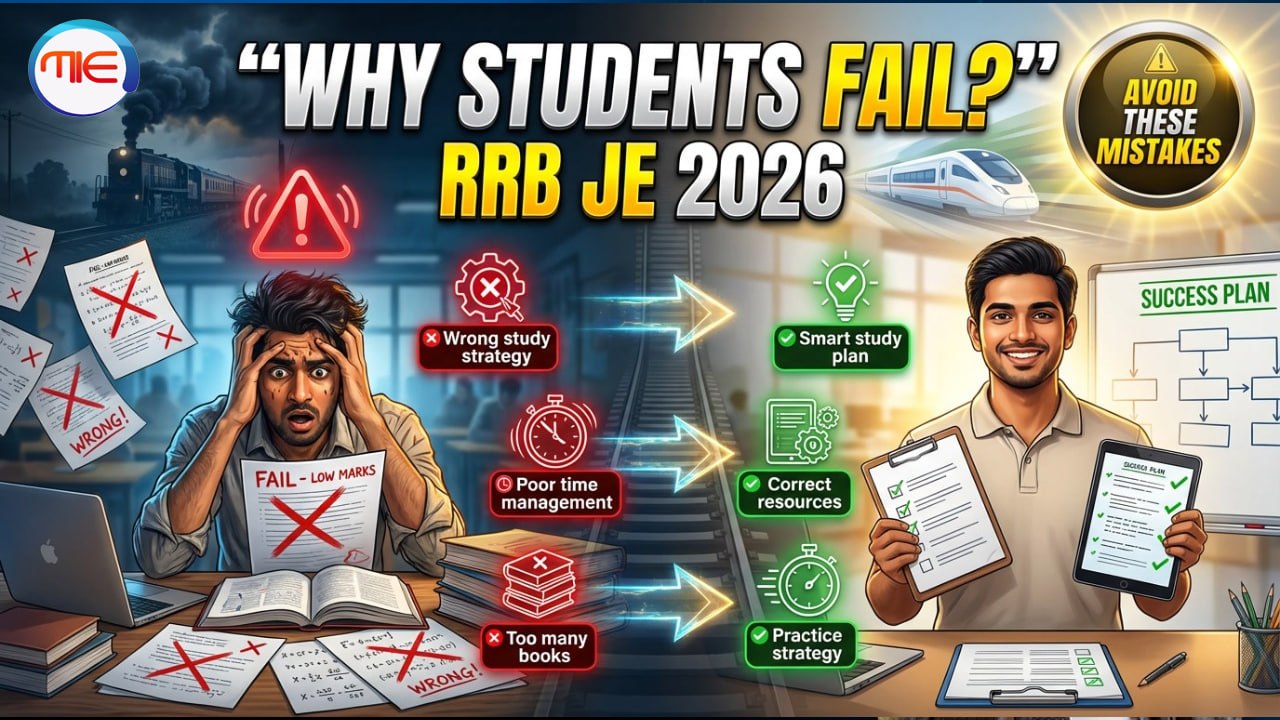
After analyzing the preparation patterns, results, and feedback from previous RRB JE aspirants, we have identified the most impactful mistakes that consistently separate the selected from the rejected. Each mistake below comes with a clear, actionable fix.
This is the single most devastating strategic error. Thousands of students spend an equal or even disproportionate amount of time on CBT 1 preparation — drilling general awareness, reasoning puzzles, and aptitude questions — while giving their engineering technical subjects secondary attention. Since CBT 1 is a qualifying-only stage with marks that have zero impact on the final merit list, this approach is fundamentally flawed.
The reality is that CBT 2 carries 150 marks, and the technical section alone accounts for 100 of those marks. If you score marginally in CBT 1 but brilliantly in CBT 2, you will be selected. The reverse is never true.
Allocate roughly 60–70% of your total study time to CBT 2 technical subjects. Treat CBT 1 as a hurdle to clear efficiently, not as a competition to top. Aim to score comfortably above the cut-off in CBT 1 without obsessing over perfection in that stage. Direct your energy toward building deep technical mastery for CBT 2.
The RRB JE exam carries a 1/3 negative marking for every wrong answer in both CBT 1 and CBT 2. This seems straightforward, but most students either ignore this completely or overcompensate by becoming overly cautious. Both extremes are harmful.
Consider the mathematics: if you guess randomly among 4 options, statistically you will get 1 right and 3 wrong in every 4 attempts, resulting in a net score of 1 − (3 × 0.33) = 0 marks. Random guessing is mathematically neutral at best and disastrous when your guesses are worse than random (which happens under exam pressure). Students who guess on 20–25 questions typically lose 4–6 crucial marks, which can be the difference between selection and rejection.
Attempt a question only if you can eliminate at least 2 of 4 options confidently. If you can narrow it to 2 options, the math works in your favor. Never attempt questions where you have no idea of the answer. Practice this discipline rigorously in mock tests so it becomes instinctive during the actual exam.
| Scenario | Attempted | Correct | Wrong | Net Score | Outcome |
|---|---|---|---|---|---|
| 100% accuracy (ideal) | 80 | 80 | 0 | 80.0 | Excellent |
| Disciplined (80% acc.) | 80 | 64 | 16 | 58.7 | Good |
| Random guessing (25%) | 100 | 25 | 75 | 0.0 | Wasteful |
| Panic guessing (15%) | 100 | 15 | 85 | -13.3 | Disqualifying |
Previous Year Question Papers are arguably the single most valuable preparation resource for RRB JE, yet a surprising number of students either skip them entirely or treat them as an afterthought to be done in the last week before the exam. RRB has a documented history of repeating question patterns, similar numerical problems, and recurring topic weightages across cycles.
Students who thoroughly analyze and solve PYQs from 2015, 2019, and the recent cycles consistently outperform those who rely purely on textbooks, because PYQs train you for the actual difficulty level and style of questions — not a theoretical version of the exam.
Solve at least 5–7 years of previous year papers under timed conditions. After solving, perform a deep-dive analysis: identify which topics appear most frequently, which question types consume most time, and where your accuracy is lowest. Use this analysis to rebalance your study plan every 2–3 weeks.
RRB is well-known in the competitive exam community for asking questions from virtually any corner of the syllabus, including topics that appear minor or unlikely. Many students cherry-pick "high-weightage" topics and deliberately skip what they perceive as low-probability areas. This approach backfires repeatedly. Students often lose 8–12 marks in CBT 2 simply because they chose to skip topics that ended up contributing 6–10 questions in the actual exam.
The Mathematics section in CBT 1, for instance, covers everything from BODMAS to Statistics. Technical sections are even more expansive. Missing even two or three topics creates noticeable gaps.
Cover the entire syllabus. This doesn't mean you study every topic to the same depth — prioritize high-weightage topics for deeper mastery, but ensure you have at least a working understanding of all topics. A 15-minute overview of a "minor" topic can save you from losing 2–3 marks.
| Subject | Topic | Approx. Qs | Priority |
|---|---|---|---|
| Mathematics | Number System, Simplification, LCM/HCF | 6–8 | High |
| Mathematics | Percentage, Profit/Loss, Ratio | 5–7 | High |
| Reasoning | Analogies, Series, Coding-Decoding | 8–10 | High |
| General Science | Physics, Chemistry, Life Sciences | 18–25 | High |
| General Awareness | Current Affairs, General Knowledge | 12–15 | Medium |
Reading textbooks and watching video lectures creates a comfortable illusion of preparation. The real exam is a completely different experience — 90 minutes of high-stakes decision-making, time pressure, question sequencing choices, and the physical demand of sustained concentration. Students who have never practiced under timed, exam-like conditions are always caught off guard, regardless of how much theory they know.
Start taking full-length, timed mock tests at least 6–8 weeks before the exam. Aim for at least 15–20 mock tests before CBT 1 and another 15–20 before CBT 2. After each mock test, spend as much time analyzing your errors as you spent taking the test.
Spending 4–5 minutes on a single difficult question while ignoring 10 easier questions is one of the most common in-exam mistakes. The RRB JE paper is designed such that not all questions carry the same difficulty, but all questions carry the same mark.
Develop a two-pass strategy. In the first pass, attempt all questions you can answer within 60–90 seconds. Mark difficult questions for review. In the second pass, return to marked questions. Never spend more than 2 minutes on any single question.
The Technical Abilities section in CBT 2 carries 100 out of 150 marks and is entirely branch-specific. Students who focused too much on general aptitude at the cost of their technical core subjects consistently underperform in this section.
Study technical subjects at the right depth — engineering diploma/B.Tech level, not research level. Use RRB JE-specific technical guides and standard reference books for core concepts.
Following the right schedule is not about working harder — it is about working smarter. Here is a practical month-by-month blueprint that addresses all the mistakes discussed above.
Month 1–2
Foundation Building
|
Month 3–4
Intensive Practice
|
Month 5–6
Revision & Mocks
|
Studying 6–7 hours every single day for 6 months is far more effective than studying 14 hours a day for 3 months and burning out. Build a sustainable daily routine and protect it fiercely.
After every topic, create a one-page concise note capturing key formulas, facts, and concepts. In the final 2 weeks before the exam, these short notes — not thick books — are what you revise.
RRB JE questions are framed to test application of concepts, not rote memorization. If you understand why a formula works, you can derive it during the exam. Always prioritize understanding over mugging.
The gap between students who clear RRB JE and those who don't is rarely about intelligence or raw academic ability. It is almost always about strategy, consistency, and avoiding preventable mistakes. The RRB JE 2026 opportunity with 2,585 vacancies is real and within reach if you start immediately.
Use this guide as your starting reference, follow a realistic study plan, and take mock tests seriously. That is the mindset of a selected candidate.
Bookmark this guide, share it with your fellow aspirants, and begin your structured preparation today.
Download RRB JE Syllabus PDF 2026
Makeiteasy






.jpg)

“Download our app now to unlock a world of convenience and seamless access to our extensive range of features, including live and recorded classes, study material, Test series and thousand of practice questions—all at your fingertips!”


Leave a Comment