

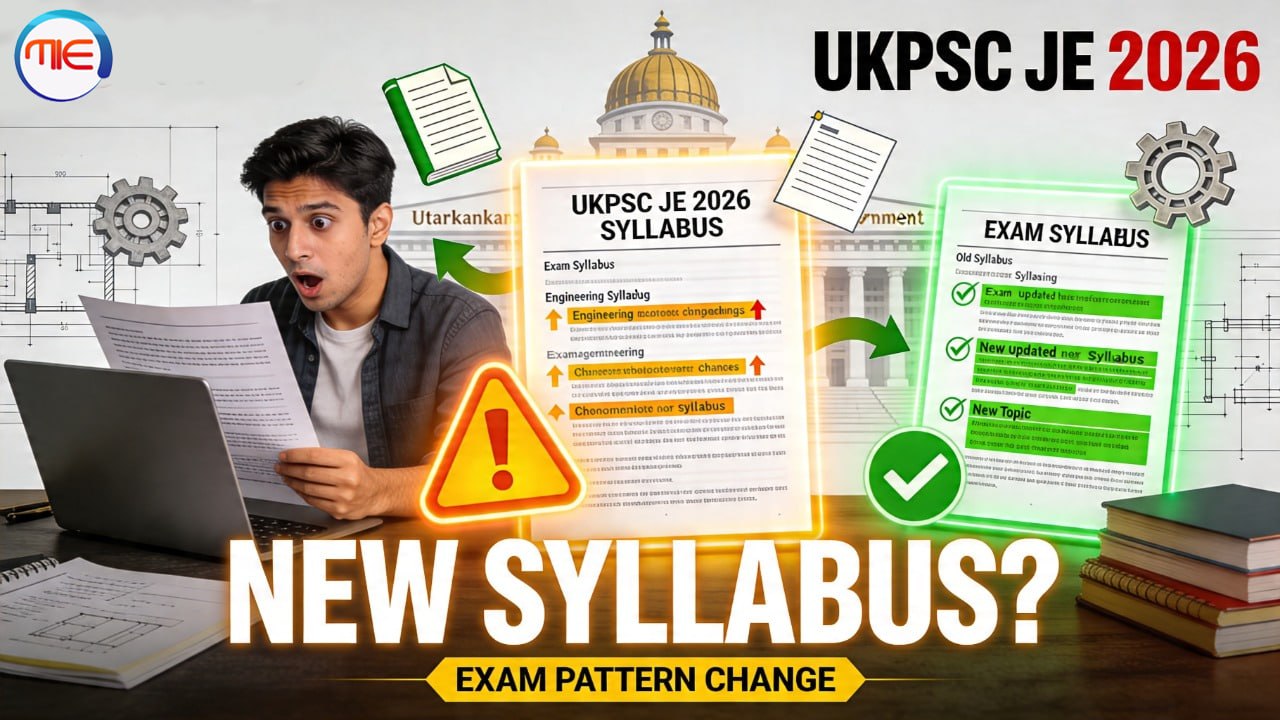
The UKPSC Junior Engineer (JE) 2026 exam is one of the most important state engineering recruitment exams conducted by the Uttarakhand Public Service Commission (UKPSC). Every year, thousands of diploma and engineering graduates prepare for this exam to secure a government engineering job in Uttarakhand.
However, many aspirants are currently asking an important question: "Will the UKPSC JE 2026 syllabus or exam pattern change?"
As of now, the official notification confirming major changes has not been released, but based on previous recruitment patterns and available information, the structure of the exam is expected to remain largely similar. If any modifications are announced in the future, candidates should update their preparation strategy accordingly.
In this guide, we will explain:
Before diving into the syllabus, let's quickly understand the structure of the examination.
| Particular | Details |
|---|---|
| Exam Name | UKPSC Junior Engineer Examination |
| Conducting Body | Uttarakhand Public Service Commission |
| Exam Mode | Offline / OMR Based |
| Question Type | Objective Type (MCQs) |
| Total Marks | 920 Marks |
| Negative Marking | 0.25 Marks per wrong answer |
| Selection Process | Written Exam + Document Verification |
The exam mainly evaluates language ability and technical engineering knowledge of candidates.
The exam consists of two major papers including language subjects and technical engineering subjects.
| Paper | Subject | Questions | Marks | Duration |
|---|---|---|---|---|
| Paper 1 | General Hindi | 100 | 100 | 2 Hours |
| Paper 1 | General English | 100 | 100 | 2 Hours |
| Paper 2 | Engineering Paper 1 | 180 | 360 | 3 Hours |
| Paper 2 | Engineering Paper 2 | 180 | 360 | 3 Hours |
| Total | — | 560 | 920 | 10 Hours |
The syllabus is divided into three major sections: General Hindi, General English, and Engineering Discipline (Civil / Mechanical / Electrical / Agricultural).
The Hindi section evaluates basic grammar and language skills. This section is generally considered scoring if grammar concepts are clear.
| Topics | Details |
|---|---|
| Grammar | Sandhi, Samas, Prefix & Suffix |
| Vocabulary | Synonyms, Antonyms |
| Sentence Formation | Sentence Correction |
| Comprehension | Unseen Passage |
| Idioms | Muhavare & Lokoktiyan |
| Word Formation | Word Structure |
This section checks the candidate's understanding of English grammar and vocabulary. Candidates should focus on basic grammar rules and vocabulary practice.
| Topics | Details |
|---|---|
| Reading | Comprehension |
| Grammar | Tenses, Articles, Prepositions |
| Vocabulary | Synonyms & Antonyms |
| Sentence Structure | Active / Passive Voice |
| Speech | Direct & Indirect Speech |
| Language | Idioms and Phrases |
The technical syllabus depends on the engineering branch selected by the candidate. Below is the detailed branch-wise breakdown.
| Paper | Subject Area |
|---|---|
| Paper 1 | Strength of Materials |
| Paper 1 | RCC Design |
| Paper 1 | Surveying |
| Paper 1 | Soil Mechanics |
| Paper 1 | Building Materials |
| Paper 1 | Steel Structures |
| Paper 1 | Environmental Engineering |
| Paper 2 | Irrigation Engineering |
| Paper 2 | Hydrology |
| Paper 2 | Fluid Mechanics |
| Paper 2 | Hydraulic Machines |
| Paper 2 | Canal Design |
| Paper 2 | Dams and Barrages |
| Paper | Topics |
|---|---|
| Paper 1 | Applied Mechanics |
| Paper 1 | Theory of Machines |
| Paper 1 | Mechanics of Solids |
| Paper 1 | Machine Design |
| Paper 1 | Industrial Engineering |
| Paper 1 | Quality Control |
| Paper 2 | Thermal Engineering |
| Paper 2 | Boilers |
| Paper 2 | Refrigeration & Air Conditioning |
| Paper 2 | Hydraulics |
| Paper 2 | Manufacturing Processes |
| Paper 2 | Production Technology |
| Paper | Topics |
|---|---|
| Paper 1 | Basic Electrical Engineering |
| Paper 1 | Electrical Machines |
| Paper 1 | Electronics |
| Paper 1 | Electrical Materials |
| Paper 1 | Power Generation |
| Paper 2 | Network Theorems |
| Paper 2 | Induction Motor |
| Paper 2 | Switchgear & Protection |
| Paper 2 | Power Distribution |
| Paper 2 | Utilization of Electrical Energy |
Although the official notification has not confirmed major modifications, some possible updates that candidates should watch include:
Some state exams are shifting to online CBT format. UKPSC may follow the same trend in future cycles.
The commission may streamline paper timing to make the exam more efficient for candidates.
Certain engineering topics may be revised according to modern diploma syllabus standards to align with current industry practices.
Vacancies fluctuate each year, which may affect cutoff trends and overall competition levels.
To crack the exam in the first attempt, follow these proven strategies:
Technical papers contribute 720 out of 920 marks, so they carry the highest weight. Prioritize technical preparation above everything else.
Previous papers help you understand:
Most questions come from diploma-level fundamentals. Ensure your conceptual foundation is solid before attempting advanced topics.
Mock tests improve three critical skills:
Make short revision notes for formulas and important concepts. Regular revision ensures strong retention closer to exam day.
| Section | Expected Difficulty |
|---|---|
| General Hindi | Easy |
| General English | Easy to Moderate |
| Technical Subjects (Engineering Papers) | Easy to Moderate |
Currently, no official confirmation of major syllabus changes has been released. Candidates should prepare according to the existing syllabus until an official notification is published by UKPSC.
The exam consists of four sections across two papers, including General Hindi, General English, and two technical engineering papers.
Yes. 0.25 marks are deducted for each incorrect answer. Candidates should avoid guessing randomly.
The written examination carries a total of 920 marks.
The engineering technical papers carry 720 marks, making them the most important and highest-weighted sections of the exam.
The UKPSC JE 2026 examination remains one of the most competitive engineering recruitment exams in Uttarakhand. While there is currently no official confirmation of major syllabus changes, aspirants should stay updated with announcements from the commission.
The best strategy is to start preparation based on the existing syllabus, focus on technical subjects, and regularly practice previous year questions.
Makeiteasy




.jpg)
“Download our app now to unlock a world of convenience and seamless access to our extensive range of features, including live and recorded classes, study material, Test series and thousand of practice questions—all at your fingertips!”


Leave a Comment