

.jpg)
| Parameter | Details |
|---|---|
| Exam Name | RRB JE CBT-2 (Mechanical Engineering) |
| Conducting Body | Railway Recruitment Boards (RRBs) |
| Total Vacancies (CEN 05/2025) | 2,585 (JE, DMS, CMA combined) |
| CBT-1 Exam Dates | February 19, 20 & 25, 2026 |
| CBT-2 Exam Date | To be announced (tentatively August–September 2026) |
| Total Questions (CBT-2) | 150 MCQs |
| Total Marks | 150 Marks (1 mark per question) |
| Duration | 120 Minutes (2 Hours) |
| Negative Marking | 1/3 mark deducted per wrong answer |
| Mode of Exam | Online (Computer-Based Test) |
| Type of Questions | Objective Type — Multiple Choice Questions (MCQ) |
| Safe Score Target | 120+ marks (out of 150) |
| Subject / Section | No. of Questions | Marks | Nature |
|---|---|---|---|
| General Awareness | 15 | 15 | Common |
| Physics & Chemistry | 15 | 15 | Common |
| Basics of Computers & Applications | 10 | 10 | Common |
| Basics of Environment & Pollution Control | 10 | 10 | Common |
| Technical Abilities (Mechanical Engineering) | 100 | 100 | Branch-Specific |
| TOTAL | 150 | 150 | — |
The RRB JE CBT-2 Mechanical 2026 exam is the defining stage of your Railway Junior Engineer journey. Unlike CBT-1, which is merely qualifying in nature, CBT-2 determines your final merit rank — meaning every mark you score here directly influences whether your name appears on that coveted selection list. With 2,585 vacancies announced under CEN 05/2025 and lakhs of aspirants competing for each seat, the margin between selection and elimination can be razor-thin.
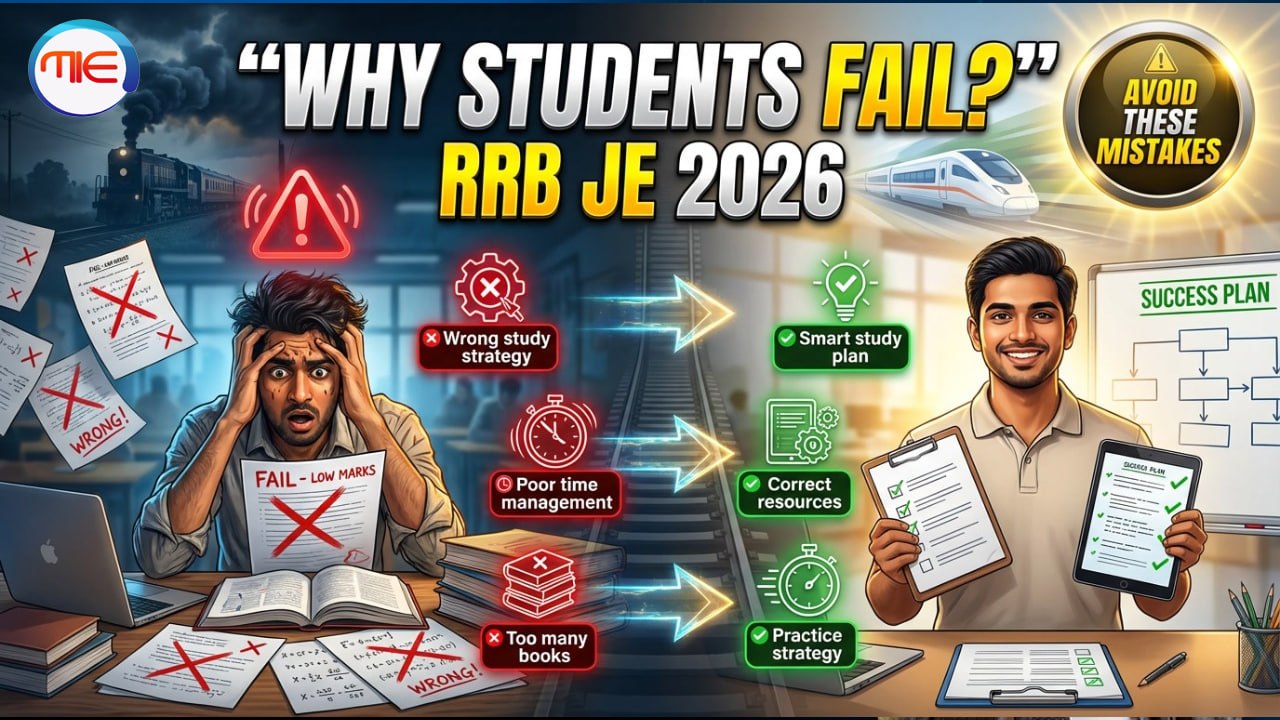
Here is what most aspirants never realize: it is not always a lack of knowledge that costs them the exam — it is avoidable mistakes. Skipping high-weightage topics, mismanaging 120 minutes across 150 questions, guessing recklessly under negative marking, or approaching the non-technical sections carelessly — these are the silent score-killers that quietly separate the selected from the rejected.
In this comprehensive guide, we break down every significant mistake that Mechanical Engineering aspirants make during preparation and on exam day, backed by previous year analysis and preparation insights. Read this carefully, and you will know exactly what to fix before you walk into that exam hall.
The single biggest mistake a CBT-2 aspirant can make is jumping into studying without first deeply understanding what the exam actually tests. RRB JE CBT-2 is not a GATE or ESE-level exam — it does not demand mastery at a postgraduate depth. However, it does demand complete breadth across a well-defined syllabus. Aspirants who treat it like GATE (going too deep into a few topics) and those who are too casual (skipping core technical topics) both pay the price.
The Mechanical Engineering technical section carries 100 out of 150 marks — a massive two-thirds of the entire paper. Approximately 80–90% of questions are theoretical or conceptual, while only 10–20% are numerical. This means understanding the 'why' behind concepts is far more important than memorizing complex formulas.
| Subject | Key Topics Covered |
|---|---|
| Engineering Mechanics | Force systems, equilibrium, friction, centroid & centre of gravity, simple machines, kinematics, dynamics of rigid bodies |
| Strength of Materials (SOM) | Stress & strain, bending moment & shear force diagrams, torsion, elasticity, deflection of beams, columns & struts, Poisson's ratio |
| Theory of Machines (TOM) | Governors, cams, gears, flywheels, balancing of rotating masses, velocity & acceleration diagrams, tool-life law |
| Thermodynamics | Laws of thermodynamics, thermodynamic cycles (Carnot, Otto, Diesel, Rankine), heat transfer, refrigeration & air conditioning, IC engines, psychrometry |
| Fluid Mechanics | Fluid statics, Bernoulli's equation, flow through pipes, Reynolds number, hydraulic machines (Pelton, Francis, Kaplan turbines), centrifugal pumps |
| Manufacturing Technology | Casting, welding (arc, gas, resistance), machining processes, sheet metal work, metrology, CNC basics, surface finish, process parameters |
| Material Science | Crystal structure, iron-carbon diagram, heat treatment, properties of metals (steel, cast iron, aluminium, copper), composites, ceramics |
| Machine Design | Design of shafts, keys, couplings, springs, bearings, riveted & welded joints, fasteners, design for fatigue |
| Industrial Engineering | Production planning & control, work study, inventory management (EOQ), quality control, network analysis (CPM/PERT), plant |
Treating all subjects equally is a classic time-management blunder. Previous year question paper analysis clearly shows that certain subjects contribute far more questions than others. Aspirants who spend equal time on every topic end up under-prepared in high-weightage subjects while over-investing in low-yield areas.
Based on a detailed analysis of RRB JE Mechanical previous year papers, the following subject-wise weightage pattern has emerged — and it carries direct implications for how you should allocate your study time.
| Subject | Approx. Questions | Approx. Weightage % | Priority Level |
|---|---|---|---|
| Manufacturing Technology | 18–22 | ~22% | Highest Priority |
| Strength of Materials | 12–16 | ~15% | Highest Priority |
| Thermodynamics & Heat Transfer | 12–18 | ~15–18% | High Priority |
| Material Science | 8–12 | ~10% | High Priority |
| Industrial Engineering | 8–10 | ~9% | High Priority |
| Fluid Mechanics | 8–10 | ~9% | Medium Priority |
| Theory of Machines | 5–8 | ~6–8% | Medium Priority |
| Engineering Mechanics | 5–8 | ~6% | Medium Priority |
| Machine Design | 3–6 | ~4–5% | Lower Priority |
RRB JE CBT-2 carries a penalty of 1/3 mark for every wrong answer. This is not just a technicality — it fundamentally changes the mathematics of how you should attempt the exam. Many aspirants, especially those used to attempting state-level exams without negative marking, fall into the trap of 'attempting everything' and end up losing more marks than they gain.
To understand the severity, consider this: if you attempt 20 uncertain questions and get 10 right and 10 wrong, you gain 10 marks but lose 3.33 marks in penalties — a net of only 6.67 marks instead of 10. However, if those 10 wrong answers had been left blank, you would have saved yourself from unnecessary deduction while still scoring 10 marks from the correct ones.
| Your Confidence Level | Recommended Action | Why |
|---|---|---|
| 80–100% sure (You know the answer) | Attempt confidently | Maximum score gain with minimal risk |
| 50–80% sure (Can eliminate 2 options) | Attempt with caution | Elimination improves probability significantly |
| Below 50% (Pure guessing) | SKIP — do not attempt | Expected loss outweighs expected gain |
Previous Year Question Papers are arguably the most underutilized resource in RRB JE preparation. Aspirants who skip PYQs in favour of reading textbooks chapter by chapter are making a critical strategic error. The RRB JE exam has a recognizable question pattern, and several topics are repeated — sometimes almost verbatim — across different exam years and shifts.
Solving PYQs gives you three irreplaceable advantages: you learn the actual difficulty level (which is moderate, not GATE-level), you identify which sub-topics within each subject are repeatedly tested, and you develop an intuition for the examiner's preferred question style — whether they like formula-based numericals, definition-based theory, or application-based scenarios.
| Phase | Activity | Goal |
|---|---|---|
| Phase 1 (During Learning) | Solve PYQs topic-wise after finishing each chapter | Validate your understanding before moving forward |
| Phase 2 (Mid Preparation) | Solve full previous year papers under timed conditions | Build exam stamina and time management |
| Phase 3 (Final Revision) | Re-solve all wrong answers; maintain an error notebook | Eliminate repeat errors and reinforce weak areas |
You have exactly 120 minutes to attempt 150 questions — that works out to 48 seconds per question on average. While the non-technical sections (General Awareness, Physics & Chemistry, Computers, Environment) are relatively quicker to attempt, the technical section demands more thinking time for some questions. Without a pre-decided time strategy, aspirants waste precious minutes on difficult questions and rush through easy ones, resulting in avoidable errors.
| Section | Questions | Time (Minutes) | Strategy |
|---|---|---|---|
| General Awareness | 15 | 10–12 | Attempt first — quick and definitive |
| Physics & Chemistry | 15 | 12–15 | Easy scoring if 10th standard is strong |
| Basics of Computers | 10 | 8–10 | Mostly factual — attempt fast |
| Environment & Pollution | 10 | 8–10 | Factual — quick scoring |
| Technical (Mechanical) | 100 | 75–80 | Core focus — attempt strong areas first |
| Buffer / Review Time | — | 5–7 | Review marked questions |
There are two opposing groups of aspirants who both make fatal errors when it comes to mock tests. The first group avoids mock tests entirely, preferring to 'finish the syllabus first' — they enter the exam unfamiliar with real-time pressure, and their performance suffers. The second group takes test after test but never pauses to analyze results — they repeat the same mistakes cycle after cycle without improvement.
The real power of a mock test lies in the 30–45 minutes of analysis after it. Experts recommend treating mock test analysis as a separate study session: identify every wrong answer, classify the error type (conceptual gap, calculation mistake, misread question, or random guess gone wrong), and then target those specific weak areas in the next study session.
| Error Type | How to Identify | Corrective Action |
|---|---|---|
| Conceptual Error | You chose an answer based on wrong understanding of the concept | Revisit the topic from basics; make a concept note |
| Calculation Mistake | You knew the concept but made an arithmetic/unit error | Practice more numericals; double-check units carefully |
| Reading Error | You misread a keyword like 'NOT', 'maximum', or 'minimum' | Slow down during reading; underline keywords mentally |
| Blind Guess Error | You had no idea and guessed randomly — got it wrong | Identify the topic; study it; next time, skip if unsure |
| Time Pressure Error | You knew the answer but rushed and marked incorrectly | Improve time management; build speed through daily practice |
Because CBT-2 is widely seen as a 'technical exam,' many Mechanical aspirants commit significant preparation time to the 100-mark technical section and almost none to the 50-mark non-technical section. This is a costly miscalculation. Those 50 marks — from General Awareness, Physics & Chemistry, Computers, and Environment — are actually easier to score and more predictable than technical questions.
A candidate who scores 65/100 in technical and 45/50 in non-technical will score 110 total — much better than a candidate who scores 75/100 technically but only 25/50 in non-technical, ending at 100. The non-technical section is where disciplined aspirants build a comfortable buffer.
| Section | Marks | Key Focus Areas |
|---|---|---|
| General Awareness | 15 | Current affairs (last 6 months), Indian Railways GK, national policies, sports, awards, geography, constitution basics |
| Physics & Chemistry | 15 | 10th standard CBSE level — laws of motion, optics, electricity, periodic table, chemical reactions, acids & bases |
| Basics of Computers | 10 | MS Office, Operating Systems, Internet basics, hardware components, shortcut keys, generations of computers |
| Environment & Pollution Control | 10 | Types of pollution, greenhouse effect, ozone layer, Indian environmental laws, ecology basics, renewable energy |
Almost every aspirant has at least two or three subjects that feel uncomfortable — perhaps Fluid Mechanics, Theory of Machines, or Machine Design. The natural tendency is to keep these uncomfortable subjects for 'later' while strengthening subjects you already know well. The problem is that 'later' often arrives as 'exam week' — leaving you with no time to address genuine gaps.
The correct approach is to identify your weak subjects in the very first week of CBT-2 preparation (use a diagnostic test or solve one PYQ paper), and then allocate proportionally more daily study time to those weak areas immediately. It is far more efficient to convert a weak subject into an average one than to convert an already-strong subject into a perfect one.
RRB JE CBT-2 preparation is a marathon, not a sprint. Many aspirants follow an erratic schedule — studying 12 hours on some days and barely 2 on others. This inconsistency prevents the brain from building the cognitive stamina required for a 120-minute high-pressure exam. Research in learning science consistently shows that regular, structured study sessions of 2–3 hours are significantly more effective than irregular marathon sessions.
Experts recommend 8–10 hours of focused, quality study per day in the months leading up to the exam, structured across multiple sessions with short breaks. This isn't about grinding blindly — it is about building a daily habit where your brain is primed for problem-solving at specific hours. Many toppers deliberately study during the same time slot as their exam — training their mind to be at peak alertness at that hour.
| Time Slot | Activity | Duration |
|---|---|---|
| 6:00 AM – 8:00 AM | Revision of previous day's technical topics + formula review | 2 hours |
| 9:00 AM – 12:00 PM | New technical topic study (core subjects: Manufacturing / SOM / Thermodynamics) | 3 hours |
| 1:00 PM – 2:30 PM | Non-technical section — Current Affairs, Physics, Computers, Environment | 1.5 hours |
| 3:30 PM – 5:30 PM | PYQ practice or Mock Test (chapter-wise or full paper) | 2 hours |
| 6:30 PM – 8:00 PM | Mock test analysis + error notebook update | 1.5 hours |
| 8:30 PM – 9:30 PM | Weak subject focused study | 1 hour |
This is a trap that especially catches aspirants who have previously prepared for GATE or ESE. RRB JE is a Junior Engineer level exam — it tests foundational understanding, important formulas, and the ability to apply basic concepts, not advanced derivations or university-level proofs. Spending three days deriving the Navier-Stokes equations when you could be solving 60 RRB-level fluid mechanics questions is a textbook example of misallocated effort.
Around 80–90% of RRB JE CBT-2 questions are theoretical or straightforward conceptual questions. Focus on knowing the definitions, classification, applications, and basic formulas for every topic. Save in-depth numerical derivations only for subjects where numericals are commonly asked — such as Strength of Materials, Thermodynamic cycles, and Fluid Mechanics.
All the months of preparation can be undermined by what happens in those 120 minutes if you are not psychologically and tactically prepared for exam day. Insufficient preparation for the actual exam environment — including screen fatigue from reading MCQs on a monitor, the pressure of the clock visible in the corner, and the temptation to change answers at the last minute — can cost you dearly.
| ✅ DO This | ❌ AVOID This |
|---|---|
| Read each question fully before looking at options | Rushing to read options before finishing the question |
| Attempt non-technical sections first for quick marks | Starting with the hardest technical questions |
| Mark uncertain questions and come back later | Spending more than 90 seconds on any single question |
| Trust your first instinct for questions you know | Changing answers without a clear logical reason |
| Skip and move on for genuinely unknown questions | Guessing randomly on 15+ questions hoping for luck |
| Keep an eye on the clock every 20–25 questions | Ignoring time until only 15 minutes remain |
| Sleep for 7–8 hours before exam day | All-night last-minute cramming before the exam |
| # | Mistake | Quick Fix |
|---|---|---|
| 1 | Not knowing exam pattern & syllabus | Study the official syllabus PDF before anything else |
| 2 | Ignoring subject weightage | Prioritize Manufacturing, SOM, Thermodynamics first |
| 3 | Reckless guessing under negative marking | Only attempt when 50%+ confident after elimination |
| 4 | Skipping Previous Year Papers | Solve minimum 5–7 full Mechanical PYQ papers |
| 5 | Poor time management on exam day | Use the recommended section-wise time allocation strategy |
| 6 | Mock tests without analysis | Classify every error; maintain a Mistake Notebook |
| 7 | Underestimating non-technical (50 marks) | Dedicate 90 minutes daily to GA, Physics, Computers, Env. |
| 8 | Avoiding weak areas indefinitely | Identify weak subjects in Week 1; attack them immediately |
| 9 | Erratic study schedule | Follow a fixed daily schedule; aim for 8–10 quality hours |
| 10 | Over-studying beyond RRB JE level | Match your depth to the PYQ difficulty level |
| 11 | Poor exam day strategy | Follow the exam day DOs and DON'Ts checklist |
The RRB JE CBT-2 Mechanical 2026 exam rewards not just knowledge, but strategic, disciplined, and mistake-free preparation. The 11 mistakes outlined in this guide are not rare blunders — they are the patterns that show up repeatedly among aspirants who fall just short of the cut-off. The good news is that every single one of them is entirely preventable.
Start with a clear understanding of the syllabus and weightage. Build your study plan around high-weightage subjects like Manufacturing Technology, Strength of Materials, and Thermodynamics. Respect the negative marking, analyze your mock tests deeply, and never underestimate those 50 non-technical marks. Stay consistent, trust the process, and keep correcting your errors in real-time through your Mistake Notebook.
Indian Railways is one of the world's largest employers, and a Junior Engineer position offers not just a stable career but genuine growth opportunities. If you are putting in the hours, make sure those hours are pointed in the right direction. Avoid these mistakes, follow a smart strategy, and your name on that final merit list is a matter of time and focused effort.
Avoid the mistakes. Follow the strategy. Claim your rank.
Makeiteasy







“Download our app now to unlock a world of convenience and seamless access to our extensive range of features, including live and recorded classes, study material, Test series and thousand of practice questions—all at your fingertips!”


Leave a Comment