

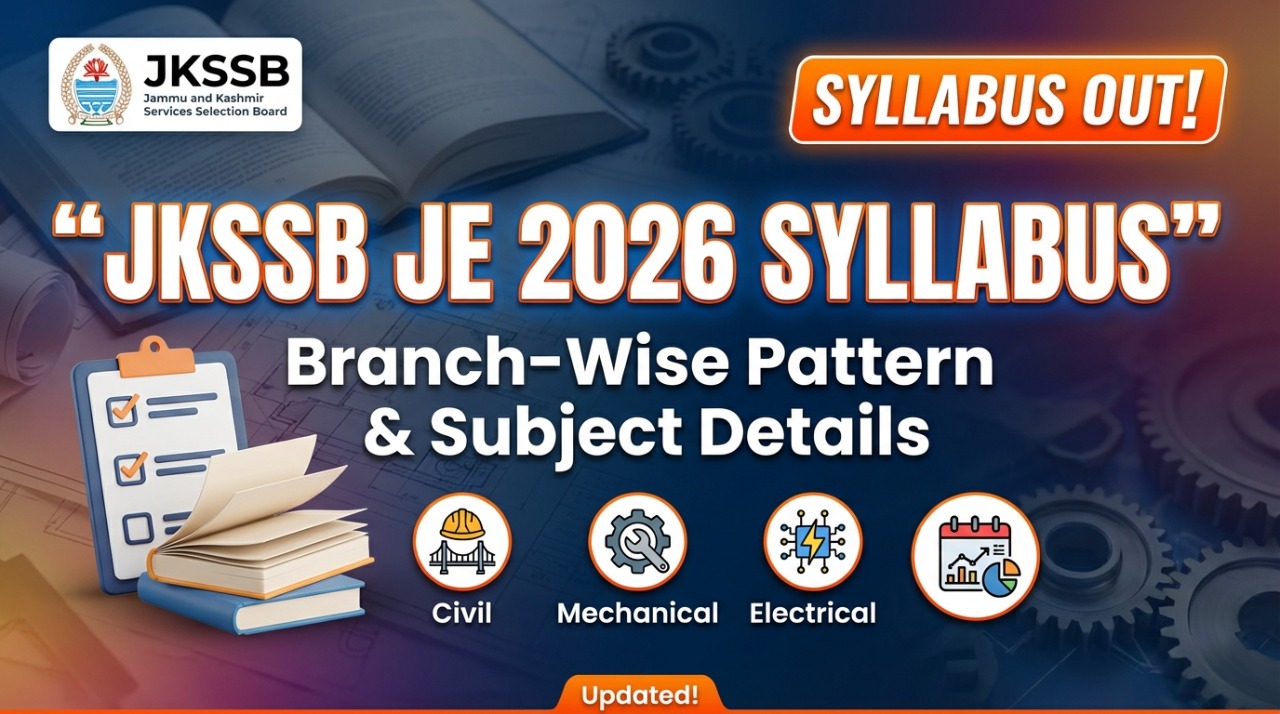
If you're preparing for JKSSB Junior Engineer (JE) 2026, understanding the syllabus is the first and most important step toward success.
Every year, thousands of candidates apply for the JKSSB JE recruitment, but only those who prepare strictly according to the official syllabus crack the exam. In this detailed guide, we will break down the JKSSB JE 2026 syllabus branch-wise, including Civil, Mechanical, and Electrical Engineering, along with the latest exam pattern.
Let’s get started.
The Jammu & Kashmir Services Selection Board (JKSSB) conducts the Junior Engineer (JE) examination to recruit candidates in various engineering departments.
| Stage | Description |
|---|---|
| Stage 1 | Written Examination (Objective Type) |
| Stage 2 | Document Verification |
There is no interview stage for most JE posts.
Understanding the exam pattern helps you align your preparation strategy.
| Particulars | Details |
|---|---|
| Mode of Exam | Offline / OMR Based |
| Question Type | Objective (MCQs) |
| Total Questions | 120 |
| Total Marks | 120 Marks |
| Duration | 2 Hours |
| Negative Marking | 0.25 marks deducted for each wrong answer |
✔ Each correct answer carries 1 mark.
✔ Questions are based on Diploma-level engineering syllabus.
The syllabus varies depending on the engineering discipline. Below is a structured breakdown.
Civil Engineering syllabus focuses on core diploma-level concepts.
| Subject | Important Topics |
|---|---|
| Building Materials | Cement, Lime, Bricks, Aggregates, Timber, Concrete |
| Structural Engineering | Strength of Materials, RCC, Steel Structures |
| Geotechnical Engineering | Soil Mechanics, Foundation Engineering |
| Environmental Engineering | Water Supply, Wastewater Engineering |
| Transportation Engineering | Highway Engineering, Traffic Engineering |
| Irrigation Engineering | Hydrology, Canal Design |
| Engineering Mechanics | Laws of Motion, Force Systems |
| Surveying | Leveling, Theodolite, Contouring |
Strength of Materials
RCC & Structural Design
Soil Mechanics
Environmental Engineering
Mechanical syllabus is focused on core mechanical concepts.
| Subject | Important Topics |
|---|---|
| Engineering Mechanics | Laws of Motion, Friction, Equilibrium |
| Thermodynamics | Laws of Thermodynamics, Heat Transfer |
| Strength of Materials | Stress, Strain, Bending Moment |
| Theory of Machines | Gears, Governors, Flywheels |
| Fluid Mechanics | Properties of Fluids, Hydraulics |
| Production Engineering | Casting, Welding, Machining |
| Industrial Engineering | Work Study, Production Planning |
| Engineering Drawing | Projections, Sections |
Thermodynamics
SOM (Strength of Materials)
Fluid Mechanics
Production Engineering
Electrical Engineering candidates must focus on circuit theory and machines.
| Subject | Important Topics |
|---|---|
| Electrical Circuits | Network Theorems, AC/DC Circuits |
| Electrical Machines | Transformers, DC Machines, Induction Motors |
| Power Systems | Generation, Transmission & Distribution |
| Control Systems | Transfer Function, Stability |
| Measurements | Electrical Instruments |
| Basic Electronics | Diodes, Transistors |
| Utilization of Electrical Energy | Illumination, Heating |
Electrical Machines
Power Systems
Circuit Theory
Now that you know the syllabus, here’s how to prepare effectively.
Focus more on core subjects like:
SOM (All branches)
Electrical Machines
RCC
Thermodynamics
Use polytechnic-level textbooks rather than advanced engineering books.
Previous year questions help you:
Understand exam trend
Identify repeated topics
Improve speed & accuracy
Attempt full-length mock tests weekly to:
Improve time management
Reduce negative marking risk
Yes, 0.25 marks are deducted for each wrong answer.
The exam is based on Diploma-level engineering syllabus.
A total of 120 objective-type questions are asked.
No, selection is generally based on written examination and document verification.
You can download the official syllabus from the JKSSB official website once the detailed notification is released.
The JKSSB JE 2026 syllabus is extensive but completely manageable if you prepare strategically. Focus on core diploma concepts, revise regularly, and practice previous year questions.
Remember — success in JKSSB JE doesn’t depend on studying everything, but on mastering the right topics.
✔ Start your preparation today, follow the official syllabus strictly, and stay consistent.
If you found this guide helpful, bookmark it and share it with fellow aspirants preparing for JKSSB JE 2026.
Makeiteasy



“Download our app now to unlock a world of convenience and seamless access to our extensive range of features, including live and recorded classes, study material, Test series and thousand of practice questions—all at your fingertips!”


Leave a Comment