

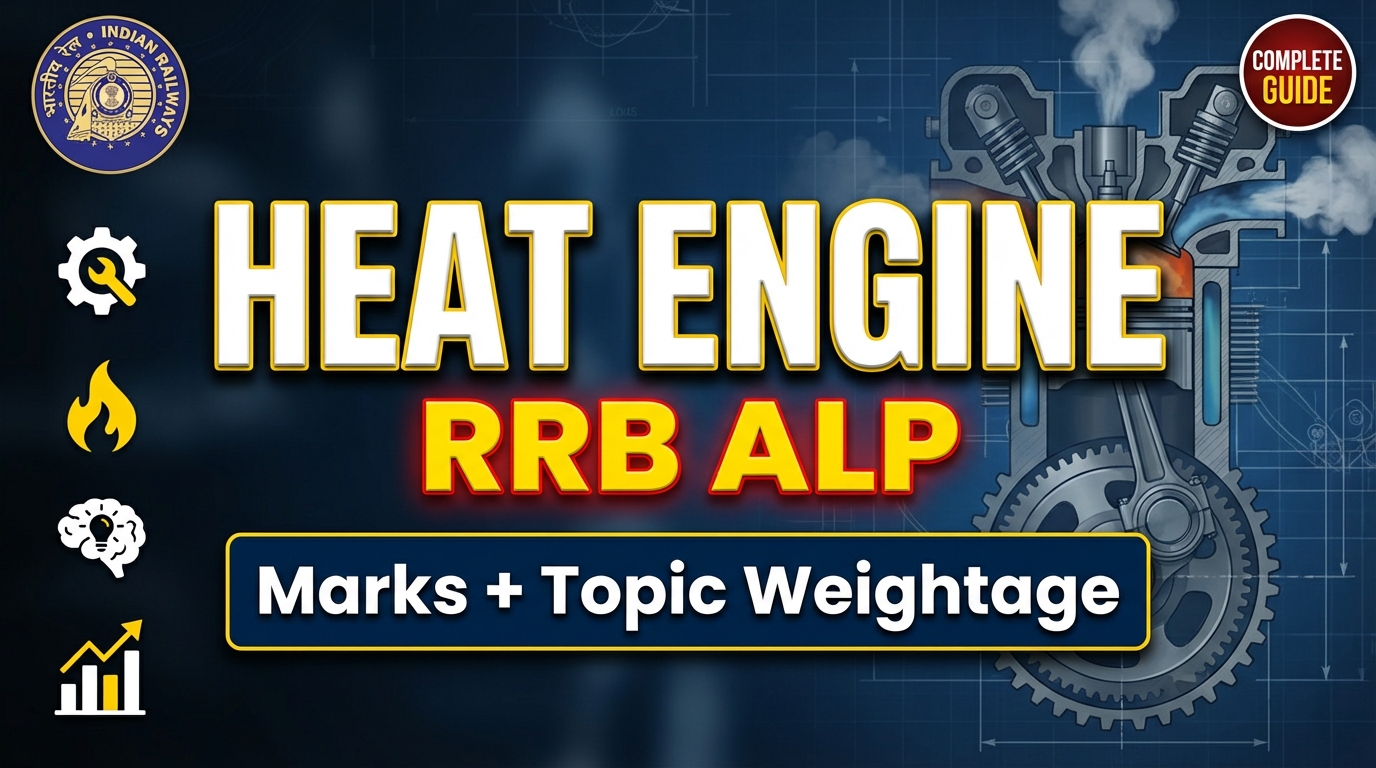
The RRB ALP (Assistant Loco Pilot) Heat Engine syllabus is one of the most important sections for candidates preparing for the CBT-2 Relevant Trade Paper. This guide breaks down all topics, marks distribution, topic weightage, and strategic insights to help you prepare smart and score high!
Whether you are a beginner or revising for the final stretch, this article provides an in-depth look into the syllabus so you know exactly what to study and how much importance to give each topic.
Before we dive into the Heat Engine section, here’s how the ALP selection process is structured:
| Stage | Exam Name | Questions | Marks | Focus |
|---|---|---|---|---|
| Stage I | CBT-1 | 75 | 75 | Math + Reasoning + Science + GA |
| Stage II | CBT-2 Part A | 100 | 100 | Math + Reasoning + Basic Sci & Engg + GA |
| Stage II | CBT-2 Part B | 75 | 75 | Relevant Trade (incl. Heat Engine) |
| Stage III | CBAT | Aptitude | – | Qualifying |
CBT-2 Part B (Relevant Trade) includes the Heat Engine syllabus — crucial for mechanical and automobile trade students.
Here is the detailed marks distribution for Heat Engine topics (based on the most credible syllabus resources available):
| Subject / Topic | Expected Marks |
|---|---|
| Internal Combustion Engine (IC Engine) | 20 |
| Hand Forging | 8 |
| Basic Fitting | 10 |
| Welding | 10 |
| Sheet Metal Work | 10 |
| Measurement | 5 |
| Basic Electricity | 7 |
| Transmission System | 5 |
| Total | 75 Marks |
This distribution gives a clear idea where most marks will come from — particularly the Internal Combustion Engine, which alone carries around ~27% of total marks.
This is the core topic in Heat Engine. You must cover:
Introduction, parts, and functions
Two-stroke and four-stroke cycle engines
Sequence of operations in an engine cycle
Advantages & disadvantages of two-stroke vs four-stroke
Valve timing diagrams (Petrol & Diesel engines)
Comparison: Petrol vs Diesel engines
Materials used in gaskets & packings
Engine starting, running & stopping precautions
Focus Area: Mechanisms and differences between petrol and diesel engines are high-yield subtopics.
Fundamental forging operations
Forge tools & dies
Temperature control in forging
Safety procedures in forging
Types of fit and tolerance
Marking, sawing, filing
Chisels, hacksaws
Surface finishing basics
Types of welding processes
Arc welding principles
Safety in welding operations
Welding defects & remedies
Bending, shearing, and cutting operations
Tools used in sheet metal
Joints and seams
Development of surfaces
Measurement tools (vernier, micrometer, gauges)
Precision & accuracy
Linear and angular measurement
Error calculations
Ohm’s law
Series & parallel circuits
Conductors & insulators
Power and energy calculations
Simple electrical diagrams
Clutch types and working
Gearbox basics
Final drive and differential
Power transmission in vehicles
High Priority Topics
Internal Combustion Engines
Welding & Fitting basics
Basic Electricity principles
Moderate Priority
Sheet metal & forging
Measurement tools
Study Tips
Start with conceptual clarity of engines and fuel cycles.
Use diagrams for IC engine parts & valve timing — visuals help retention.
Solve previous year questions related to heat engines.
Practice full length mock tests.
Although specific official heat engine books are not released by RRB, you can refer to:
Basic Engineering Trade Manuals
Mechanical Engineering basic textbooks
ITI Mechanical or Automobile books
Online video lectures for practical demos
Mock tests focused on Heat Engine portion
Q1. What is the RRB ALP Heat Engine syllabus?
The Heat Engine section covers Internal Combustion Engines, Fitting, Forging, Welding, Measurement, Basic Electricity, Sheet Metal Work, and Transmission systems with a combined total of around 75 marks in CBT-2.
Q2. How many marks does the Internal Combustion Engine topic carry?
It typically carries about 20 marks, making it the most important sub-topic.
Q3. Is the Heat Engine paper objective or subjective?
It is objective (MCQ) and part of the CBT-2 Relevant Trade Paper.
Q4. How should I prepare for the Heat Engine section?
Focus on concepts, diagrams, and real applications, solve mock papers, and revise high-weightage areas multiple times.
The RRB ALP Heat Engine syllabus is comprehensive but systematic. With the correct topic weightage knowledge and study strategy, you can target high-score areas and improve performance drastically.
Start with Internal Combustion Engines, build fundamentals in welding, fitting and measurement, and strengthen your basics in electricity and transmissions.
Makeiteasy







“Download our app now to unlock a world of convenience and seamless access to our extensive range of features, including live and recorded classes, study material, Test series and thousand of practice questions—all at your fingertips!”


Leave a Comment