

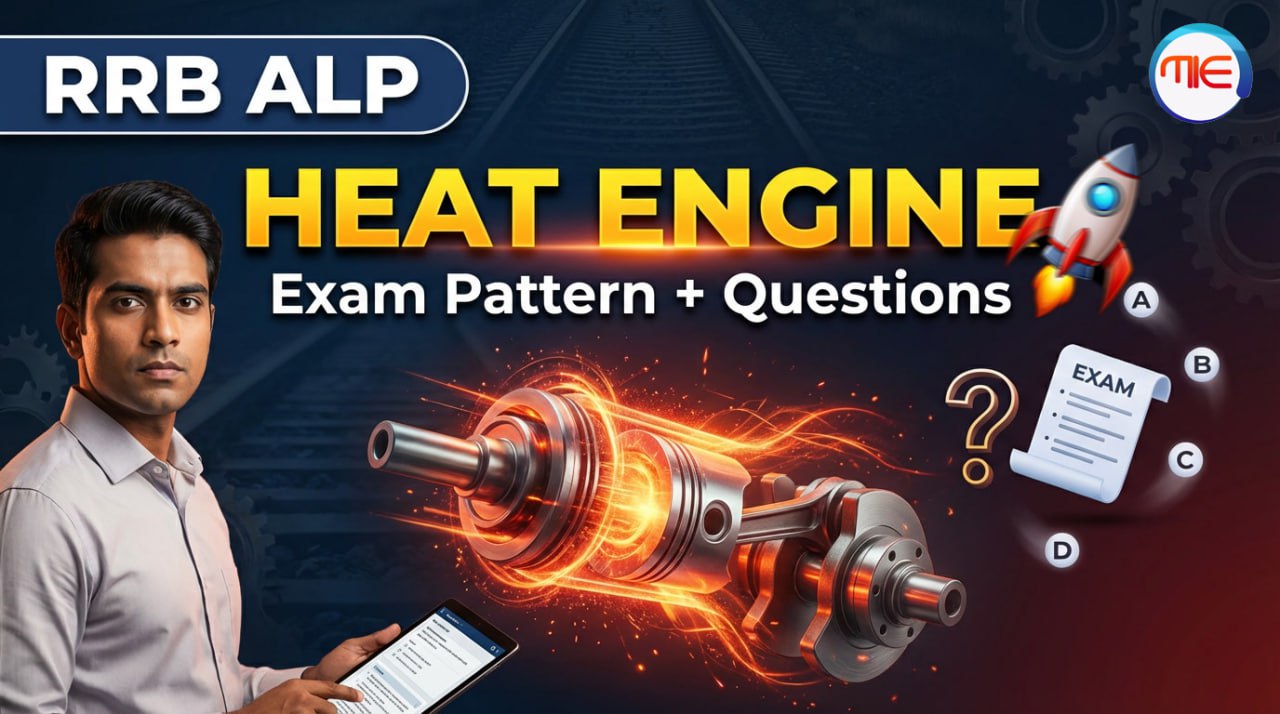
Understanding the Heat Engine exam pattern is essential for scoring well in the RRB ALP CBT-2 Part B Relevant Trade paper. This section explains the marks distribution, question style, difficulty level, and includes realistic sample questions to help you prepare smarter.
| Component | Details |
|---|---|
| Exam Type | Objective (Multiple Choice Questions) |
| Total Questions | 75 |
| Total Marks | 75 |
| Duration | 60 Minutes |
| Qualifying Marks | 35% (For UR/OBC/EWS) |
| Negative Marking | Yes (1/3rd per wrong answer) |
| Content | Trade-specific syllabus (Heat Engine for Mechanical/Automobile trades) |
This is based on analysis of ITI pattern + previous ALP trade papers:
| Topic | Expected No. of Questions | Difficulty |
|---|---|---|
| Internal Combustion Engines | 20–22 | Moderate to High |
| Welding | 8–10 | Easy |
| Fitting (Basic) | 8–10 | Moderate |
| Sheet Metal Work | 6–8 | Easy |
| Hand Forging | 5–7 | Moderate |
| Measurement Tools | 5–6 | Easy to Moderate |
| Basic Electricity | 6–8 | Moderate |
| Transmission System | 4–5 | Moderate |
➡️ Most questions come from IC Engines + Welding + Fitting.
RRB usually asks conceptual + application-based questions.
Questions are not numerical-heavy, but revolve around:
✔ Working principles
✔ Identification of parts
✔ Differences/advantages
✔ Diagrams (theoretical questions)
✔ Safety and operational basics
Below are realistic exam-oriented examples.
1️⃣ Which stroke in a four-stroke petrol engine is responsible for producing power?
A) Suction
B) Compression
C) Power
D) Exhaust
✔ Answer: C
2️⃣ Which engine component converts reciprocating motion into rotary motion?
A) Piston
B) Crankshaft
C) Camshaft
D) Connecting rod
✔ Answer: B
3️⃣ Diesel engine uses which ignition system?
A) Spark plug
B) Glow plug
C) Fuel injector + Compression ignition
D) Magneto ignition
✔ Answer: C
1️⃣ Arc welding uses which type of current?
A) AC
B) DC
C) Both AC & DC
D) None
✔ Answer: C
2️⃣ A common welding defect caused by insufficient heat is:
A) Porosity
B) Undercut
C) Lack of fusion
D) Crack
✔ Answer: C
1️⃣ Vernier caliper least count is typically:
A) 0.02 mm
B) 0.01 mm
C) 0.1 mm
D) 0.2 mm
✔ Answer: A
2️⃣ Which tool is used for marking parallel lines?
A) Scriber
B) Try square
C) Divider
D) Surface gauge
✔ Answer: D
1️⃣ Ohm’s Law is expressed as:
A) V = IR
B) P = VI
C) R = V/I
D) V = I/R
✔ Answer: A
2️⃣ A series circuit has:
A) Same current everywhere
B) Same voltage everywhere
C) Different current at each load
D) No resistance
✔ Answer: A
1️⃣ The component that transfers power from the gearbox to the wheels is:
A) Differential
B) Clutch
C) Propeller shaft
D) Flywheel
✔ Answer: C
| Topic | Difficulty | Why |
|---|---|---|
| IC Engine | ⭐⭐⭐⭐ | Concept-heavy, many subtopics |
| Welding | ⭐⭐⭐ | Mostly simple factual questions |
| Fitting | ⭐⭐⭐ | Basic ITI-level concepts |
| Sheet Metal | ⭐⭐ | Easy, repetitive |
| Basic Electricity | ⭐⭐⭐⭐ | Conceptual (laws, circuits) |
| Transmission System | ⭐⭐⭐ | Mechanical fundamentals |
Understand four-stroke & two-stroke cycles
Study diagrams & valve timing
Compare petrol vs diesel engines
Most questions are theory-based
Read ITI manuals (Automobile / Fitter trades)
Focus on least count, accuracy, errors
Expect 4–5 easy questions here
Ohm’s law
Series & parallel circuits
Power calculations
Practice improves speed
Helps understand question patterns
✔ Make short notes of engine parts & cycles
✔ Memorize standard tool dimensions (e.g., least count)
✔ Review welding defects & safety measures
✔ Practice 200+ trade questions before exam
✔ Avoid guesswork — negative marking applies
The Heat Engine section is scoring if you understand concepts and practice the ITI-level questions. Expect:
75 objective questions
Mostly conceptual and application-based
Higher weightage for IC engines
Manageable difficulty
No advanced calculations needed
If you follow a structured preparation plan, scoring 50+ out of 75 is absolutely achievable.
Makeiteasy

“Download our app now to unlock a world of convenience and seamless access to our extensive range of features, including live and recorded classes, study material, Test series and thousand of practice questions—all at your fingertips!”


Leave a Comment